

Your career is more than a resume.
EPS builds an evidence-based understanding of you and your career so you can make better decisions about the opportunities that matter—and determine how to position yourself when you choose to pursue one.
A resume compresses years of experience into a few pages. EPS starts underneath the resume—and with the person behind it.
Understand you. Understand your career. Understand the opportunity. Position yourself. Build the case.
Request Early AccessWhy not just use a great AI prompt?
You can—and for some applications, that may be enough.
A strong prompt and a capable AI model can improve an existing resume, tailor it to a job description and produce polished application materials.
But the model can only reason from what you give it.
A resume is a compressed representation of your career. Important experience may have been removed for space, written for a previous opportunity, expressed in different sector language or never recognized as relevant.
A great prompt can make better use of your resume. EPS is designed to understand what your resume leaves out—and the person behind it.
That allows EPS to address more important questions:
- 01
Is this an opportunity I should pursue?
- 02
What does my career demonstrate that matters here?
- 03
Where does my experience transfer—and where are the real gaps?
- 04
How do I best position myself for this opportunity?
EPS is built for selective search—not mass application.
Not more applications. Better decisions about the opportunities that matter.
The difference is not simply better writing. It is where the reasoning begins.
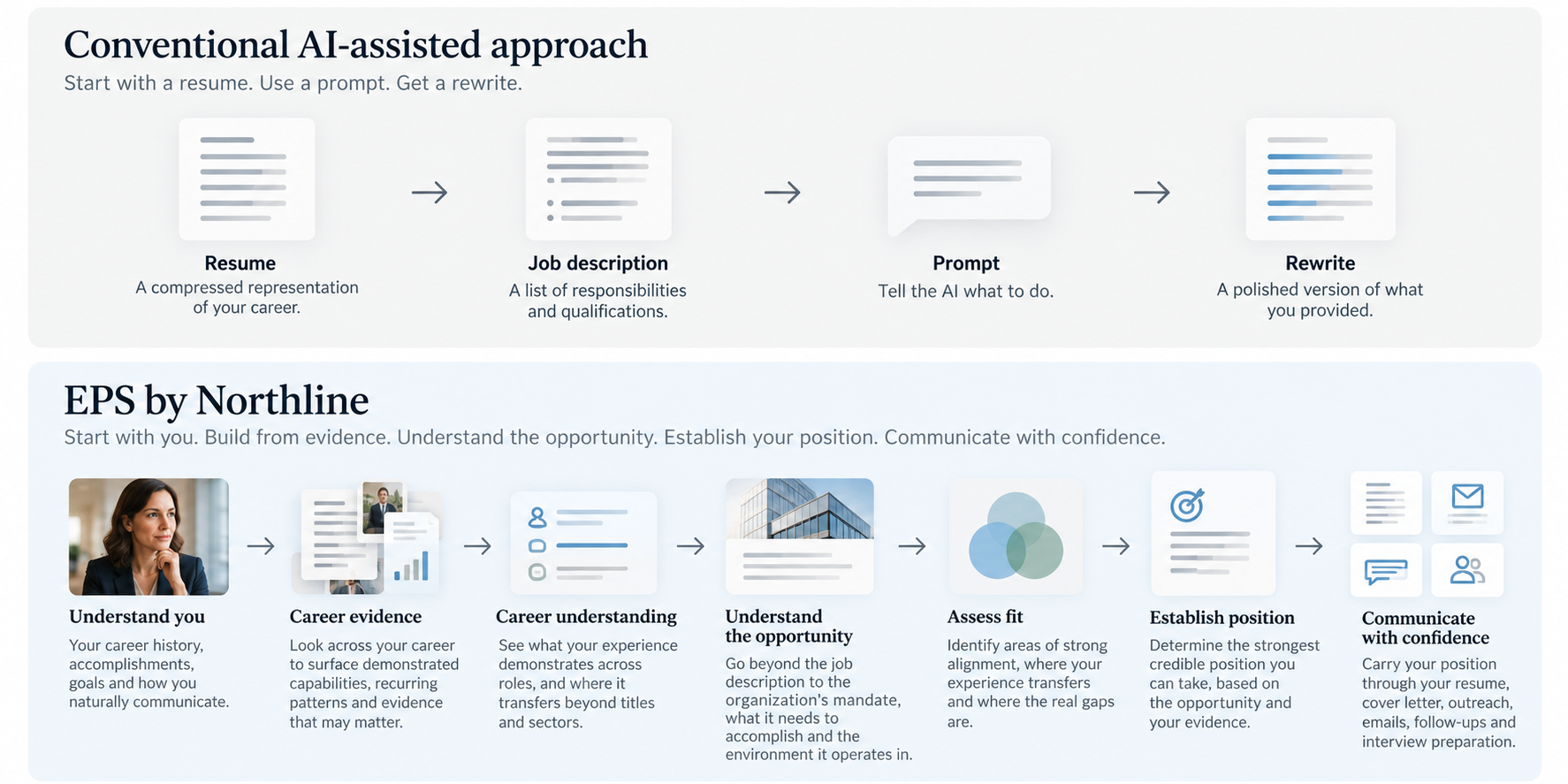
Conventional AI-assisted tools typically start with a resume and a job description, then ask the model to produce a better version of the document.
EPS starts earlier—with an understanding of you and your career evidence—and uses that foundation to understand the opportunity, assess fit, establish a credible position and communicate it consistently.
It starts with a deeper understanding of you.
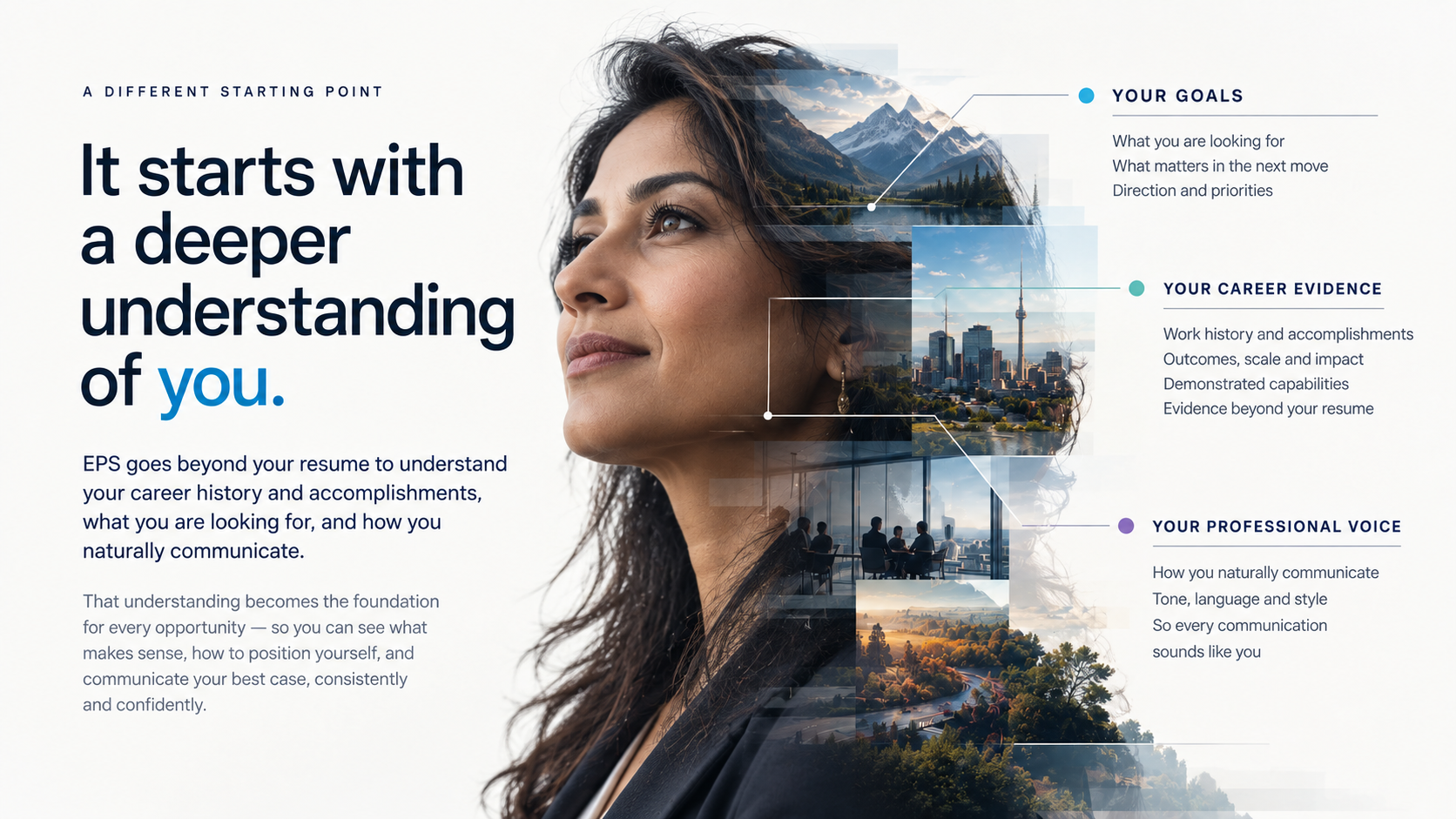
EPS goes beyond your resume to understand your career history and accomplishments, what you are looking for, and how you naturally communicate.
That understanding becomes the foundation for every opportunity—so you can see what makes sense, how to position yourself, and communicate your best case consistently and confidently.
See more of what your career makes possible.
A complex career can be difficult to see clearly from inside it—and even harder to represent in a conventional resume.
EPS looks across your career to surface demonstrated capabilities, recurring patterns and evidence that may matter beyond the role, title or sector where it was developed.
The application is built from the career evidence—not the other way around.
See your career more clearly.
Understand what your experience demonstrates across roles.
See opportunities differently.
Look beyond titles and keywords to what the organization actually needs.
Recognize where your experience transfers.
Find credible relevance across sectors, roles and environments.
Build a stronger case.
Bring evidence from across your career to the opportunity.
You are not limited to the opportunities your current resume happens to resemble.
Understand the opportunity. Then understand your position in it.
A job description is only a representation of an opportunity. Behind the responsibilities and qualifications is a mandate: what needs to be accomplished, the capabilities required and the environment in which it needs to happen.
Understand the opportunity.
What does this organization actually need this person to accomplish?
Understand the fit.
Where is there strong evidence of alignment? Where does your experience transfer? Where are the meaningful gaps?
Determine your position.
Given the opportunity and your evidence, what is the strongest credible position you can take?
EPS isn't designed to make you fit an opportunity. It helps determine what the evidence says—and how you should position yourself when the fit is credible.
One position. One consistent story. Every interaction.
Once your position is established, EPS helps carry it through the communications surrounding the opportunity.
These are not disconnected pieces of generated content. Each draws from the same understanding of you, your career evidence and the position established for the opportunity.
The goal is a consistent, evidence-based case that still sounds like you—just you, better positioned.
Built on evidence. Not invention.
Generative AI can interpret, reason and communicate. But generated language should not quietly become career fact.
Evidence before generation.
What you have actually done comes before what AI writes.
Reasoning before writing.
Determine the position and available evidence before generating language.
Improvement without invention.
Improve the application without expanding beyond what the evidence supports.
Human authority.
AI can analyze, recommend and generate. You retain authority over what represents you.
EPS uses AI to reason from evidence—not to replace it.
Your career doesn't start over with every application.
New roles add experience. New accomplishments provide evidence. Different opportunities reveal different forms of relevance. Your priorities and professional direction evolve.
EPS is designed around a persistent understanding of you and your career rather than disconnected application sessions.
The value compounds in the understanding—not in the number of applications produced.
EPS is being designed for experienced professionals and executives conducting selective, high-value searches—and for recruiters, executive search professionals, career and executive coaches, and outplacement professionals whose work depends on understanding and positioning people well.
Built through research. Tested through engineering.
EPS is a working Northline system developed through research into governed AI, evidence-based reasoning, decision intelligence, iterative optimization and governed learning.
The engineering has a practical purpose: use the power of generative AI without allowing generated language to quietly become unsupported career fact.
Better decisions. Stronger positioning. A case built around you.
Not more applications. Better decisions about which opportunities to pursue, a stronger evidence-based position when you do, and consistent communication that helps you put your best foot forward.