

Research Paper · Data & AI
Beyond the Model
A Governed Architecture for Consequential AI Systems
Consequential AI requires an architecture that governs evidence, artifacts, evaluation, authority and learning around the model.
How governance, planning discipline, organizational capability, and leadership enable coordinated execution.

Throughout my career, I have encountered organizations with capable leadership teams, substantial technology investments, and credible strategic ambitions that nevertheless struggled to translate those advantages into sustained operational improvement. Individual departments were often performing their responsibilities effectively, but their decisions were not always connected to a broader understanding of organizational priorities, shared dependencies, or the resources available to execute change.
This fragmentation is difficult to address through conventional project management because its causes extend beyond individual initiatives. Departments develop solutions to the problems immediately in front of them, technology teams respond to competing demands, and governance committees attempt to reconcile priorities after commitments have begun to take shape. The resulting inefficiencies do not necessarily indicate poor judgment within any particular function. They often reflect an operating model that has not adequately addressed how decisions made in one part of the organization affect others.
The response is frequently another strategic plan, an additional governance committee, or a new set of approval requirements. These measures can be useful, but their existence does not establish that the organization has developed the capability to make coordinated decisions. Where underlying authority, accountability, or planning practices remain unclear, additional procedures may increase administrative effort without improving execution.
My experience has led me to distinguish between agreement on strategic direction and the organizational capability required to carry it through. An organization may achieve broad support for modernization while leaving unresolved who has decision authority, how investments will be prioritized, what resources are available, and how established ways of working must change. Consensus can contribute to progress, but sustained alignment depends on mechanisms that allow legitimate differences in responsibility and perspective to be reconciled through informed decisions and coordinated action.
Decentralized organizations depend on specialized expertise and distributed authority. Different functions operate under distinct obligations, with different expectations concerning service quality, risk, resources, and performance. Those differences are often necessary, but they also create circumstances in which decisions that improve performance locally impose costs elsewhere.
Enterprise technology provides a useful illustration. A department may acquire a specialized application because existing systems do not appear to meet a legitimate requirement. Another may establish an independent reporting environment to obtain timely information, while employees elsewhere continue relying on spreadsheets or manual processes because the enterprise platform is difficult to use or its capabilities are poorly understood.
During enterprise application assessments, I have encountered underutilized systems, disconnected reporting environments, duplicated applications, and processes maintained outside established enterprise platforms. Some reflected functional needs that had not been adequately addressed. Others resulted from incomplete implementation, inadequate training, unclear ownership, or processes that had never been redesigned to use the capabilities already available.
Replacing the underlying platform would not necessarily have resolved these conditions. Unless the organization also addressed the decisions, responsibilities, and operating practices surrounding the technology, it risked carrying existing inefficiencies into a newer and potentially more expensive environment.
A related difficulty arises when responsibility for an enterprise system resides within one department, although the information and capabilities it provides support significant workflows elsewhere in the organization. Systems supporting workforce administration, financial management, and organizational reporting illustrate this challenge. Decisions concerning configuration, information definitions, or integration can have consequences for resource planning, operational processes, and institutional reporting that extend well beyond the function responsible for administering the system.
In my experience, these dependencies are not always fully understood or represented when decisions are made. The issue is not necessarily unwillingness to cooperate or a failure of departmental leadership. Often, the organization has not established the architectural understanding, cross-functional engagement, or governance arrangements needed to make those relationships visible.
This distinction matters because operational responsibility for a system does not automatically provide the institutional perspective required to manage its wider dependencies. Decisions affecting shared information and enterprise processes need to account for the functions that rely on them, without unnecessarily removing authority from the departments responsible for day-to-day operations.
Recognizing these relationships does not mean every function should surrender control over its systems or processes. Local flexibility may be essential to professional obligations, specialized services, or regulatory responsibilities. The question is where that autonomy serves a legitimate purpose and where decisions have consequences requiring broader coordination.
I regard this as selective alignment. Organizations should preserve functional differences where they contribute to effective operations while coordinating decisions involving material shared dependencies, institutional resources, or risks that extend beyond the authority of a single function. The objective is not uniformity but an appropriate relationship between local discretion and organizational accountability.
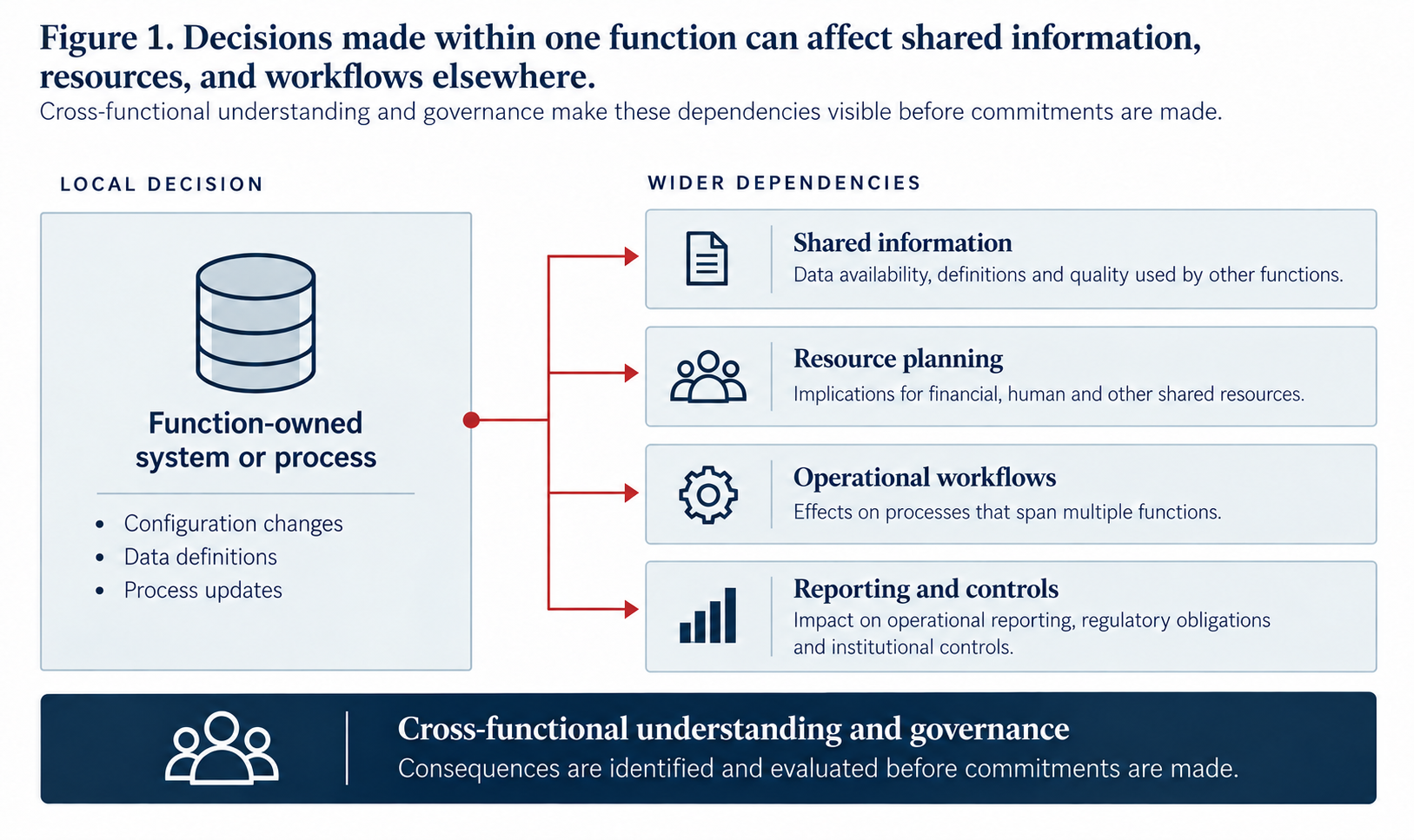
Governance is frequently introduced to address fragmentation, yet its effectiveness depends on whether it improves decision-making rather than simply increasing the number of procedures through which proposals must pass.
Committees, evaluation criteria, business cases, and approval requirements serve legitimate purposes. They establish financial discipline, support risk management, and provide evidence that organizational obligations have been considered. Difficulties arise when compliance with these mechanisms becomes the primary measure of governance effectiveness while authority for resolving competing priorities remains uncertain.
I have encountered arrangements in which projects were evaluated against detailed criteria without adequately addressing their relationships to other initiatives, the availability of delivery resources, or the operational consequences of proceeding. The process produced a defensible record of evaluation, but it did not necessarily produce a coherent investment portfolio.
An enterprise strategic-planning exercise provided an opportunity to address this problem more directly. The organization had accumulated nearly 100 initiatives, many responding to legitimate business requirements, but collectively they exceeded the resources and execution capacity available. Using strategy maps, Balanced Scorecards, business architecture, and portfolio management, we connected proposed investments to organizational objectives and established a more disciplined basis for determining which initiatives should proceed.
The value of this work lay less in the management frameworks themselves than in the decisions they supported. Leaders could examine dependencies, understand competing demands on resources, and distinguish strategically necessary initiatives from work that was desirable but could not reasonably proceed at the same time. The portfolio became more focused because priorities, capacity, and accountability were considered together.
However, fragmented decisions cannot always be explained by inadequate information or unclear governance. Departments may have legitimate interests that conflict with broader organizational objectives, particularly where proposed changes alter established authority, operating responsibilities, or the distribution of resources.
A department may recognize that a shared platform offers an institutional advantage while remaining concerned about losing functionality needed for its work. Another may be expected to absorb implementation costs or operational disruption while the principal financial benefits accrue elsewhere. Existing performance measures may also reward departmental efficiency without recognizing the costs transferred to other functions.
These circumstances cannot be resolved simply by improving communication. They require leaders to examine incentives, acknowledge the uneven distribution of benefits and costs, and determine which decisions are justified despite their consequences for particular groups.
The same consideration applies to decisions involving standardization and centralization. Consolidating applications may reduce duplication and simplify support while limiting specialized functionality. Centralizing services may improve consistency and resource utilization but create distance from the operational requirements of the functions being served. Decentralized arrangements may strengthen local responsiveness at the expense of greater duplication and inconsistent controls.
None of these outcomes is inherently preferable in every circumstance. Executive judgment is required to determine which trade-offs are acceptable, how the resulting obligations should be distributed, and whether the organization has the capacity to manage the consequences.
This reinforces the distinction between authority to approve an investment and accountability for realizing its intended benefits. For investments requiring changes across several functions, governance should assign responsibility for benefits realization to leaders with the authority to influence the relevant operating processes. Project delivery accountability and operational outcome accountability may be held by different individuals, but their relationship must be explicit.
Effective governance does not eliminate competing interests or ensure that every participant is satisfied with the outcome. It provides a legitimate means of considering the evidence, evaluating alternatives, exercising decision authority, and assigning responsibility for the consequences.
Technology investment is often assessed through measures associated with implementation, including project delivery, system reliability, and expenditure against budget. Although these measures are necessary, they provide an incomplete account of the investment's organizational value.
Benefits frequently depend on changes extending beyond the technology project. Employees may need to adopt different processes, managers may need to reorganize responsibilities, and departments may need to agree on common information definitions or service arrangements. When these changes do not occur, a technically successful implementation can leave much of the anticipated value unrealized.
I encountered this distinction during an operational transformation involving a service constrained by fragmented responsibilities, manual processing, and limited visibility into work in progress. Although technology formed part of the response, the improvement required a broader redesign of the service model, including digitized intake, workflow automation, a reusable knowledge base, and more specialized roles. Processing times subsequently fell by more than 50%, while service volumes increased substantially without a proportionate increase in staffing.
The improvement came from changing how the work was organized and performed, with technology supporting the revised operating model. Treating the problem solely as an application or capacity issue would have missed opportunities to improve the service.
A separate restructuring of fragmented administrative functions produced approximately $2.86 million in reduced support expenditures over three years. The financial outcome was associated with changes in organizational design and operating practices rather than technology replacement alone.
These experiences have shaped how I evaluate modernization opportunities. Before recommending substantial new investment, I want to understand the capabilities already available, the processes they support, the reasons those capabilities may be underutilized, and the changes required to achieve the intended outcomes.
Not every technology investment should be expected to produce direct financial savings. Cybersecurity, service resilience, accessibility, and regulatory compliance may be justified primarily through risk reduction or service obligations. The important requirement is to establish an appropriate definition of value and identify the operational responsibilities necessary to achieve it.
Financial evaluation must also consider consequences beyond the technology budget. A reduction in centralized service expenditure may transfer work to other departments, where the cost becomes less visible but remains real. Conversely, enterprise improvements may reduce duplicated effort across functions without producing an immediately identifiable saving within the technology organization.
Assessing organizational value therefore requires financial, operational, and technology leaders to examine the combined consequences of investment decisions rather than only the expenditure recorded within their respective budgets.
One recurring limitation of traditional technology operating models is that technology specialists are engaged after the organization has defined the problem and selected its preferred response. By the time a project reaches implementation, assumptions about processes, required capabilities, and potential alternatives may no longer be open to examination.
This arrangement limits the contribution technology professionals can make, particularly where existing enterprise capabilities could satisfy a requirement or where a proposed solution introduces dependencies that were not considered during initial planning.
Improving the relationship requires more than changing reporting arrangements or adding technology representation to senior committees. It requires established working relationships between technical specialists and the people responsible for operational and service outcomes.
Earlier in my career, I introduced a business relationship management approach intended to strengthen that connection. The work involved developing a better understanding of operational requirements, improving relationships between technology staff and service users, and establishing greater accountability for service performance. The resulting improvements included stronger client satisfaction, first-contact resolution of 70%, increased departmental productivity, and reduced operating costs.
The experience demonstrated the importance of understanding the work being supported rather than concentrating exclusively on technical service delivery. Technology professionals who understand the processes, constraints, and priorities of the functions they serve can contribute to decisions before those decisions become formal project requirements.
Business analysts, application specialists, architects, and service leaders can all perform this role, although the appropriate structure will depend on organizational circumstances and available resources. What matters is continuity of engagement and the ability to translate operational needs into informed choices about processes, information, technology, and organizational capability.
These relationships also create opportunities for constructive challenge. A request for a new application may lead to an assessment of functionality already available, while a proposed automation may reveal a process that should be simplified before technology is introduced. The purpose is to improve the quality of organizational decisions rather than expand the authority of the technology function.
The significance of this relationship is greatest when functional decisions depend on information, technology, or processes shared with other parts of the organization. Expertise embedded in a single department may not be sufficient to identify those dependencies, making enterprise architecture, business analysis, and cross-functional engagement necessary complements to local knowledge.
A credible strategy and a workable governance structure do not guarantee that an organization has the capacity to implement change. This distinction has been particularly important in my experience of leading established teams through modernization.
I have worked in environments where senior leaders supported substantial improvements, including changes to governance, technology investment, and organizational responsibilities, but where the delivery organization had developed practices that were difficult to change. As confidence in the new direction increased and previously deferred priorities received attention, demand for modernization could grow more quickly than the organization's ability to respond.
The implementation challenge was not necessarily the quality of the strategy. It concerned the relationship between the ambition of the change programme and the leadership capability, skills, available capacity, and established working practices required to deliver it.
This difficulty is frequently described as resistance, which can obscure the reasons employees question or delay a proposed change. Some concerns reflect genuine risks to service continuity or operational performance, while others arise from uncertainty, competing responsibilities, insufficient capability, or established habits. In other cases, individuals or departments may be responding rationally to changes that affect their workload, authority, resources, or professional responsibilities.
These circumstances require different management responses and cannot all be resolved through communication alone. Leadership must distinguish objections that improve the quality of implementation from behaviours that prevent agreed decisions from being carried out, while recognizing that some disagreements reflect interests that cannot be fully reconciled.
Employees should have opportunities to contribute their knowledge, particularly when their work will change, but participation does not remove management's responsibility to establish priorities and make decisions. Where the consequences are significant, leaders must explain the rationale, acknowledge the trade-offs, and establish the support and accountability necessary for implementation.
The practical work involves developing managers, clarifying responsibilities, sequencing initiatives within available capacity, and ensuring that essential services can be maintained while new arrangements are introduced. Additional investment does not automatically create additional delivery capacity when the same specialists are responsible for operating existing systems and implementing change.
An organization's ability to absorb change is therefore a resource that must be considered during planning. A portfolio may be financially affordable and technically achievable while exceeding the capacity of employees and leaders to implement it successfully. Recognizing that constraint before commitments are made allows the organization to adjust sequencing, develop capability, or reconsider the scope of its ambitions.
These experiences have led me to consider alignment through six connected operating capabilities: Shared Understanding, Shared Language, Shared Governance, Integrated Planning and Roadmaps, Organizational Readiness, and Measured Outcomes and Learning.
The individual capabilities are familiar elements of organizational management. Their contribution in this framework lies in examining how they depend on one another and identifying where weaknesses in their application prevent an organization from translating strategic direction into coordinated execution.
The framework is drawn from practitioner experience and is intended as a diagnostic and operating guide rather than a formally validated maturity model or a prescribed implementation sequence. It does not presume that greater centralization or uniformity is necessarily desirable. Instead, it considers which decisions require coordination, which can remain local, and which capabilities are preventing the organization from acting on its priorities.
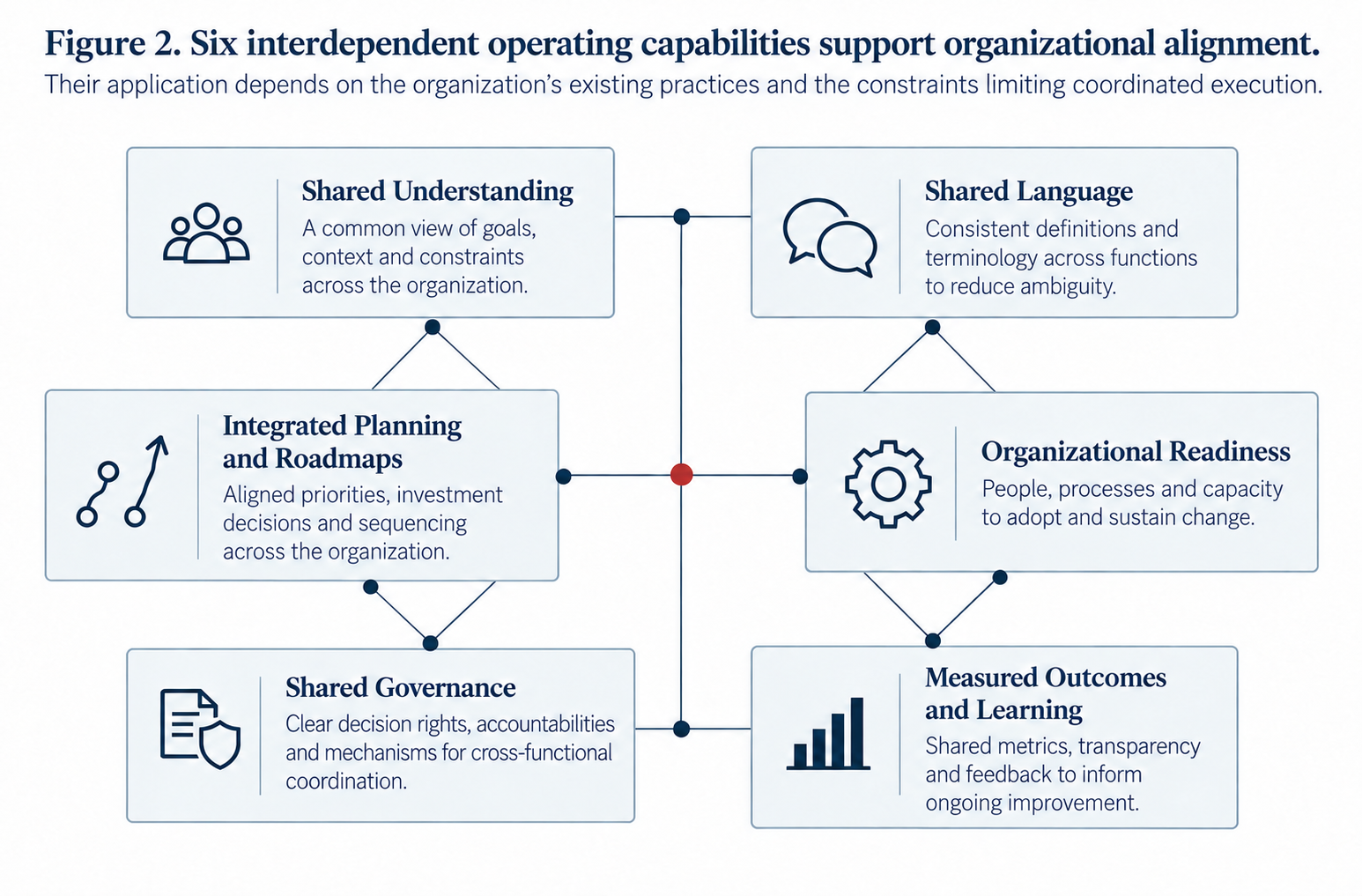
Effective decisions require a sufficiently reliable view of the organization's priorities, financial commitments, operational performance, technology capabilities, risks, and delivery constraints. When functions work from different assumptions or incompatible information, their decisions may be reasonable individually but difficult to reconcile.
Understanding must extend beyond common performance reports to the relationships between systems, information, operational processes, and organizational responsibilities. These dependencies are not always apparent to the function responsible for a particular application or service, particularly where information is reused for resource planning, financial decisions, or operational control elsewhere in the organization.
The practical starting point may be a common inventory of significant investments, existing systems, critical information flows, operational risks, and committed resources. More advanced reporting and analytical capabilities can follow as the organization develops the necessary information governance and management practices.
Terms such as modernization, service excellence, efficiency, and risk can conceal materially different expectations. A modernization initiative may be understood as infrastructure replacement by one group, process automation by another, and service redesign by a third.
Before significant commitments are made, leaders need to establish what the intended change means in operational terms, which outcomes are expected, and how success will be evaluated. This allows different professional perspectives to be reconciled without assuming that agreement on terminology represents agreement on substance.
Shared language is particularly important when decisions involve multiple professional disciplines. Financial, operational, technology, and service leaders may examine the same initiative through different measures of success, and those differences need to be understood before investment and delivery commitments are established.
Governance must distinguish decisions that can appropriately remain within individual functions from those requiring broader coordination. It should establish authority, accountability, evaluation criteria, and escalation mechanisms proportionate to the consequences of each decision.
The objective is to preserve appropriate functional autonomy while recognizing that decisions involving shared systems, resources, information, or institutional risks may require wider authority. Governance must also account for competing incentives and circumstances in which implementation responsibilities or costs fall on functions that do not receive the principal benefits.
For investments requiring changes across several functions, governance must establish who owns the intended benefits and who has authority to make the necessary operational decisions. The responsibility for delivering a project may differ from the responsibility for achieving and sustaining the improvements it supports, and both must remain visible throughout the investment lifecycle.
An organization cannot coordinate plans it has not developed or reliably execute priorities that have not been translated into actionable commitments.
Some organizations have established planning processes but struggle to connect activities across functional boundaries. Others have limited planning discipline, with priorities emerging through individual requests, operational pressures, or annual budget discussions rather than a coherent process for translating strategy into execution.
Where planning capability is limited, the initial requirement may be a single organizational or functional roadmap establishing priorities, sequencing, responsibilities, dependencies, and realistic resource commitments. The immediate objective is to create a credible plan that leaders can use to guide decisions and assess progress.
As planning capability develops, separate functional roadmaps can be established or connected where organizational requirements justify them. These plans should reveal shared dependencies and competing resource demands while allowing individual functions to retain the detail necessary for their work.
The central capability is disciplined planning rather than the number of roadmaps produced. A coherent plan that is understood, maintained, and used in decision-making is more valuable than multiple detailed plans disconnected from operational commitments.
Even a well-governed and realistically planned initiative can fail if the organization lacks the leadership, skills, relationships, operating practices, or capacity required to implement it.
Readiness must therefore be assessed explicitly rather than assumed to follow from strategic agreement or project approval. This includes the ability of managers to lead changes in responsibilities, the availability of specialist skills, the capacity of employees to adopt new arrangements, and the ability to maintain essential services during implementation.
Where significant gaps exist, leaders must determine how they will be addressed through development, recruitment, external expertise, process redesign, or changes in sequencing. They must also consider whether the proposed changes create incentives or burdens that could undermine adoption even where adequate technical capability exists.
Alignment must ultimately be assessed through changes in organizational performance rather than the existence of strategies, committees, or roadmaps. Improvements in service reliability, administrative efficiency, information quality, risk management, or financial performance provide evidence that coordinated decisions have produced practical value.
The evaluation process should examine both whether the intended outcomes were achieved and whether the assumptions connecting the investment to those outcomes proved correct. An initiative may improve technical reliability without reducing administrative workload as expected, or it may achieve an immediate efficiency improvement that proves difficult to sustain.
These findings should inform subsequent decisions about process design, resource allocation, organizational capability, and future investment. This requires defined ownership of performance measures and a willingness to investigate results that differ from expectations, rather than treating project completion as sufficient evidence of success.
The six capabilities are interdependent, but organizations will not necessarily need to strengthen them in the same order. Improving every element simultaneously may be neither affordable nor necessary, particularly where limited management and delivery capacity is itself part of the problem.
An organization without basic planning discipline may need to establish a credible roadmap before attempting extensive coordination across functions. Another may have well-developed plans but insufficient accountability for realizing benefits, while a third may have clear priorities and adequate resources but lack the leadership capability required to implement agreed changes.
The practical starting point is to identify the constraint currently preventing progress. This requires examining where decisions are delayed, dependencies remain unresolved, resources are repeatedly overcommitted, or completed projects fail to achieve their intended outcomes.
For example, introducing more detailed performance reporting may have limited value if leaders already understand the problem but lack authority to resolve it. Similarly, restructuring governance may achieve little if the organization cannot establish a reliable account of its existing investments and obligations.
The binding constraint is not necessarily the organization's weakest capability in general. It is the weakness most consequential to the decisions and outcomes currently at issue.
Once that constraint is addressed, others may become more significant. Applying the framework therefore requires continuing diagnosis and adjustment rather than progressing through a fixed sequence of management interventions.
Its value should be judged by whether it helps leaders determine where action is needed and whether the resulting changes improve the organization's ability to make and implement decisions.
Financial pressure increases the consequences of fragmented decision-making because organizations have less capacity to absorb duplication, maintain parallel systems, or undertake initiatives that do not deliver their intended benefits. It also increases the importance of distinguishing genuine efficiency improvements from expenditure reductions that transfer costs or risks elsewhere.
Decisions about consolidation, outsourcing, platform renewal, and service delivery should therefore be evaluated through their broader operational consequences. A lower-cost arrangement may be appropriate for a standardized service, while functions requiring substantial organizational knowledge or close operational relationships may warrant a different approach. The assessment should consider service performance, capability, risk, and longer-term cost rather than purchase price or departmental expenditure alone.
Financial constraints also expose the distributional consequences of organizational decisions. An initiative may reduce total expenditure while requiring one function to absorb additional workload, relinquish resources, or change responsibilities so that another function can realize the principal benefit. Even where the overall business case is sound, implementation may be difficult unless those consequences are recognized and addressed through resource allocation and accountable decision-making.
This is another reason why the value of modernization cannot be assessed entirely within the budget of the sponsoring department. The relevant question is whether the organization has improved its overall use of resources while maintaining the service obligations and capabilities that matter.
Financial pressures are leading organizations to examine artificial intelligence as a means of improving productivity, reducing administrative costs, and sustaining services with fewer resources. These are legitimate objectives, but the expected benefits are sometimes discussed in terms of technological capability before the organization has adequately examined how the work itself needs to change.
This resembles a problem I have encountered in earlier enterprise modernization initiatives. Organizations invest in systems capable of improving efficiency but retain the processes, responsibilities, and reporting arrangements that existed before implementation. The technology may function as intended while the anticipated operating improvements remain largely unrealized.
AI creates a similar risk, with additional consequences for how decisions are made and how employees perform their work. Automating an activity within an inefficient process may reduce the time required for that activity without addressing unnecessary approvals, duplicated responsibilities, inconsistent information, or work that should no longer be performed.
A further distinction is necessary between productivity, organizational capacity, and financial savings. Reducing the time required to complete a task does not automatically reduce operating expenditure. Employees may use the released capacity to improve service levels, reduce backlogs, or perform work that could not previously be undertaken, while the organization continues to incur the original staffing costs alongside additional expenditure for AI systems, integration, evaluation, and oversight.
These outcomes may still represent substantial value, but they are not economically equivalent. A credible business case must distinguish the productivity improvement demonstrated at the task level from the organizational capacity made available and the financial consequences that can reasonably be attributed to changes in operating practices.
Realizing larger benefits may require redesigning responsibilities, removing unnecessary activities, changing service arrangements, or altering how work is resourced. These decisions cannot be delegated entirely to a technology team because they affect the responsibilities of operational managers, the capabilities required of employees, and the services delivered to the organization.
Data foundations introduce another constraint that is often underestimated. Organizations may hold substantial volumes of information while lacking consistent definitions, reliable data quality, appropriate access arrangements, or clear ownership. Applications that depend on this information can reproduce existing inconsistencies or introduce risks that are not apparent during demonstrations.
The requirements should nevertheless be proportionate to the intended use. A bounded AI application working with limited, controlled information may not require extensive enterprise data modernization, while a capability supporting workforce planning, financial decisions, or institution-wide operations may depend on more substantial improvements in data quality, integration, stewardship, and access controls.
The question is not whether every data problem must be resolved before AI can be introduced, but whether the information and controls available are adequate for the consequences of the proposed use.
My work with governed AI systems has reinforced the importance of distinguishing technical capability from operational trustworthiness. Demonstrating that a tool can perform a task does not establish that its results can be relied upon within an ongoing service, particularly where errors, incomplete information, or unclear authority could produce consequential decisions.
The Framework for Alignment at Scale provides a practical means of evaluating these conditions. It connects understanding of the work and underlying information to decisions about governance, process redesign, resource commitments, organizational readiness, and the measurement of outcomes.
The opportunity presented by AI extends beyond automating existing tasks, but realizing that opportunity requires organizations to reconsider how work is performed and managed. Approaching AI principally as a technology procurement or immediate cost-reduction exercise risks repeating the limitations of earlier modernization efforts where operating processes, data foundations, and management responsibilities were left substantially unchanged.
The measure of successful modernization is not simply the number of projects completed, applications deployed, or strategies approved. These measures describe activity and, in some cases, technical achievement, but they do not necessarily establish whether the organization has improved its ability to deliver services, manage risk, use resources effectively, or make informed decisions.
The more consequential test is whether the operating model can sustain the intended outcomes, particularly when departments have competing responsibilities, resources are constrained, and available alternatives involve consequences that cannot be eliminated through better planning alone.
That requires executives to look beyond the boundaries of their own functions. Technology leaders must understand the operational consequences of their investments, financial leaders must consider the distribution of costs and benefits, and service leaders must recognize dependencies extending beyond their immediate responsibilities. Senior leadership must establish priorities and exercise the authority needed to resolve conflicts that cannot be settled within individual functions.
This does not require eliminating decentralization or imposing uniform practices on functions with different obligations. It requires understanding when differences serve a legitimate organizational purpose and when the consequences of local decisions warrant institutional coordination.
My experience has been that developing a plausible future state is often less difficult than building the organizational capability to achieve it. The sustained work lies in establishing credible priorities, making decisions involving competing interests, developing the capacity to implement change, and evaluating whether the resulting improvements justify the effort and investment.
The Framework for Alignment at Scale provides a means of examining those responsibilities, identifying constraints, and determining where improvements to the operating model may produce the greatest benefit. Its contribution is not to remove the need for executive judgment, but to make the conditions affecting that judgment more visible.
Alignment is demonstrated through an organization's ability to make defensible decisions when legitimate priorities compete, coordinate their implementation, learn from the results, and sustain improvements that justify the investment.
Steven Boyle is the founder of Northline Advisory, a technology advisory and research practice focused on technology leadership, enterprise transformation, governance, data and governed AI. His work draws on more than two decades of executive and operational experience across higher education and public-interest organizations.
A Governed Architecture for Consequential AI Systems
Consequential AI requires an architecture that governs evidence, artifacts, evaluation, authority and learning around the model.
Governing State, Authority and Lineage
An implemented architecture for treating durable, versioned and governed artifacts—not transient model responses—as the unit of enterprise AI control.
Knowing What Supports a Conclusion
A deterministic evidence architecture for preserving and inspecting the governed relationships that actually support AI-generated conclusions.