

From Decision History to Governed Intelligence
How governed AI systems can learn from decision history without allowing accumulated experience to silently become authority.

Most enterprise AI discussions focus on models: which one is smartest, fastest, cheapest, or most accurate. Those questions matter. But they are not the questions I have found most difficult while building EPS.
The harder question is this:
How do you build a system that can learn from experience without allowing experience to silently become truth?
That distinction matters whenever AI participates in consequential decisions. A system may observe which evidence was selected, which recommendations were accepted, which drafts survived review, which options were rejected, and which decisions produced useful outcomes. Over time, that history becomes valuable.
It also becomes dangerous if the architecture cannot distinguish between what happened, what was inferred from what happened, and what has actually been approved as knowledge.
This is the problem I have been working through in EPS.
EPS began as a governed system for executive positioning and application development. It uses verified career evidence, interprets the requirements of an opportunity, selects relevant evidence, develops positioning, generates application material, evaluates the result, and supports iterative optimization.
The architecture deliberately separates probabilistic reasoning from deterministic governance. Models can interpret, recommend, compare, synthesize, and write. They cannot independently redefine the authoritative evidence, silently promote a generated inference into fact, or decide that a new artifact has become authoritative simply because it was produced later.
That solved one problem: governing AI-generated work.
It exposed another: governing what the system learns from the history of that work.
Decision History Is Not Knowledge
Suppose EPS selects a particular achievement for several technology leadership opportunities. The achievement repeatedly survives review and appears in final application packages.
That history is useful.
But what exactly has the system learned?
It may have learned that the achievement is frequently relevant to technology leadership mandates. It may have learned that reviewers tend to accept it. It may have learned that it works particularly well when the mandate emphasizes governance, transformation, or operating scale.
Or it may simply have learned that the system kept selecting the same evidence.
Those are not equivalent conclusions.
A system that treats repetition as validation can create its own feedback loop. Evidence is selected because it was selected before. A positioning strategy becomes preferred because previous versions used it. An interpretation gains confidence because the system repeatedly encounters its own earlier interpretation.
Eventually, history begins to masquerade as evidence.
That is precisely what a governed learning architecture must prevent.
A Governed Learning Architecture
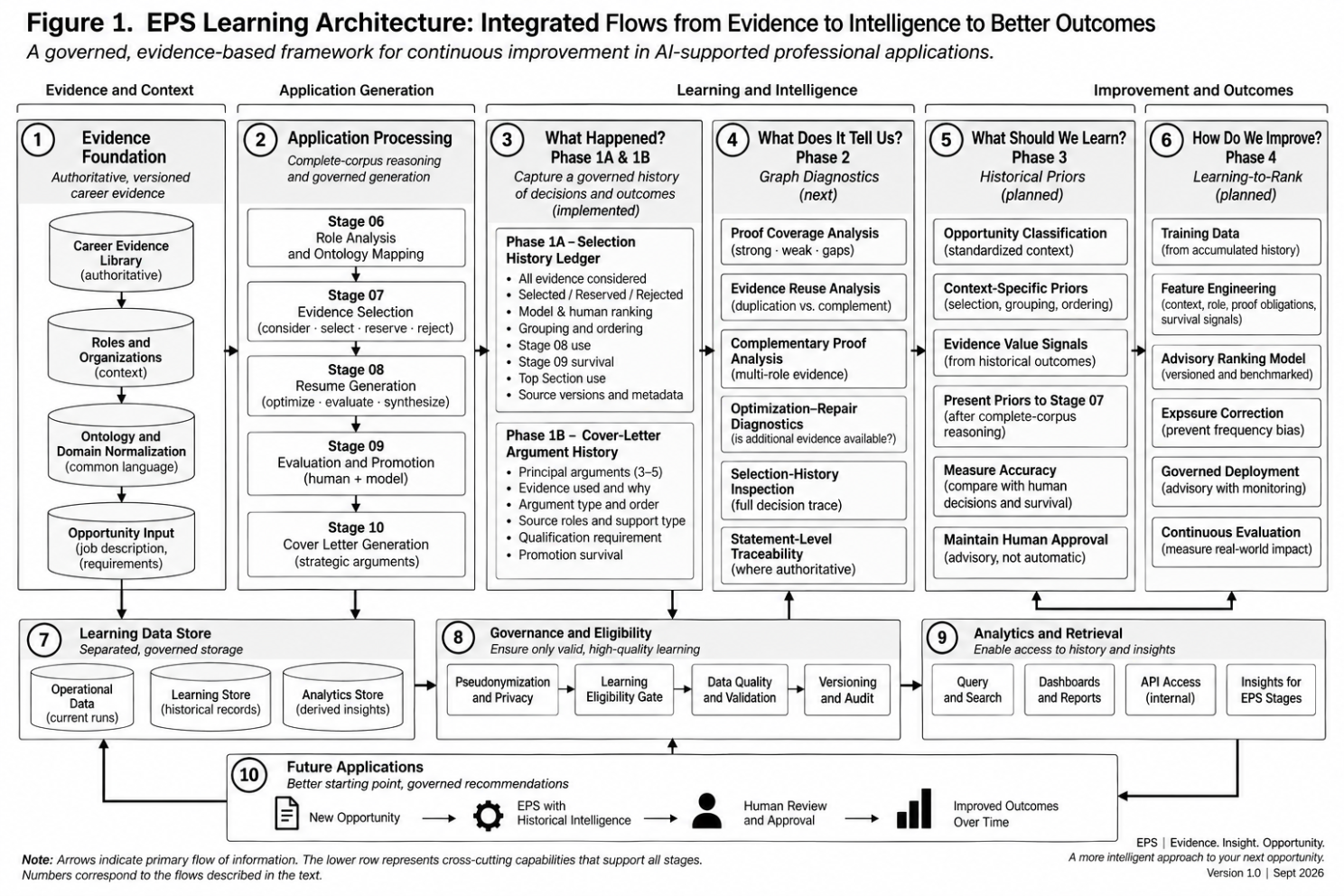
The architecture I am working toward separates several different forms of information that are often collapsed into a single idea of "memory."
We are implementing this architecture in EPS. Figure 1 shows the complete model. EPS is the working implementation; the same pattern can be applied to higher-risk corporate decision systems.
1. Evidence Foundation
The first layer contains the authoritative evidence the system is permitted to rely upon.
In EPS, that includes verified career evidence and the authoritative requirements of the opportunity being evaluated.
The important point is that this evidence does not become more or less true because the system has used it before. Its authority comes from its source and governance state, not from frequency of use.
2. Decision History
The second layer records what happened during previous decisions.
Which evidence was considered?
Which evidence was selected?
Which evidence was rejected?
What rationale was generated?
What did a reviewer change?
Which version was approved?
What was ultimately published?
This history should be preserved because it contains information about how the system and its users have behaved.
But history is observation, not authority.
3. Derived Intelligence
The third layer is where the system begins to infer patterns from decision history.
Perhaps certain achievements are repeatedly useful for particular mandate types. Perhaps some evidence combinations consistently provide stronger coverage. Perhaps reviewers regularly reject a particular interpretation. Perhaps an optimization pattern improves one class of artifact but creates regression in another.
These patterns can inform future decisions.
They should not silently become facts.
Derived intelligence needs its own identity, provenance, confidence, scope, and relationship to the observations from which it was produced.
The system should be able to explain not simply what it believes, but why it believes it and which historical observations contributed to that belief.
4. Governance Gates
Before derived intelligence influences future work, the architecture needs a governance boundary.
Some learning may be safe to apply automatically within a bounded context. Some may require human confirmation. Some may remain advisory until sufficient evidence accumulates. Some may need to be rejected because the pattern is weak, contradictory, outdated, or based on biased observations.
The important point is that learning has a lifecycle.
It can be proposed, evaluated, confirmed, revised, superseded, or rejected.
That makes learning governable.
5. Future Decision Support
Only after passing the appropriate governance gates should retained intelligence influence future decisions.
Even then, it should influence rather than replace current analysis.
A previous evidence selection may provide a useful starting point. A prior positioning strategy may deserve consideration. A known optimization pattern may suggest that another reasoning cycle is unlikely to create value.
But the new decision still has its own context, evidence, and requirements.
The system should use history to become more informed, not more presumptive.
Why Provenance Matters
This architecture depends heavily on provenance.
If the system concludes that a particular achievement is strong evidence for governance leadership, it should be possible to trace that conclusion backward:
- to the derived assertion;
- to the decisions that contributed to it;
- to the evidence used in those decisions; and
- ultimately to the authoritative source records.
Without that chain, "learning" becomes another form of opaque model state.
With it, learning becomes inspectable.
That matters because derived intelligence will sometimes be wrong.
A reviewer may correct an interpretation. New evidence may contradict an earlier pattern. A candidate's career direction may change. An organization may decide that an earlier decision should no longer influence future work.
A governed system needs to support those corrections without rewriting history.
The earlier observation still happened. The earlier inference may still have been reasonable at the time. What changes is its current governance state and the authority it has to influence future decisions.
Learning Without Losing Authority
This distinction between history and authority is central to the architecture.
Traditional machine learning often treats accumulated examples as the material from which a model learns statistical patterns. That approach can be extremely powerful.
But enterprise decision systems frequently operate under additional constraints. Some information is authoritative because of where it came from. Some interpretations require approval. Some decisions need to be reproducible. Some historical observations may be biased, incomplete, or no longer applicable.
The architecture therefore needs more than memory.
It needs governed memory.
That means preserving the original observations while separately managing the conclusions derived from them.
It also means refusing to let confidence become a substitute for authority.
A system may become highly confident that a pattern exists. That does not necessarily give it permission to rewrite the underlying evidence or treat the inference as an established fact.
What This Changes
Once learning is treated as a governed architectural capability rather than an informal memory feature, several things change.
The system can reuse prior work without blindly repeating it.
It can identify patterns without confusing patterns with facts.
It can improve recommendations while preserving the evidence that grounds them.
It can retain corrections rather than simply overwriting earlier conclusions.
It can explain why a previous decision is influencing a current one.
And it can become more useful over time without becoming progressively less auditable.
That last point matters.
Learning systems are often assumed to become more opaque as they accumulate experience. I do not think that needs to be an architectural requirement.
If learning observations, derived assertions, confidence, provenance, contradiction, correction, and governance state are treated as explicit artifacts, the system can potentially become both more capable and more explainable over time.
The Larger Question
EPS is a useful environment for exploring these ideas because the consequences are visible and the evidence is inspectable. If the system selects the wrong achievement, overstates a claim, or carries an inappropriate assumption from one opportunity into another, the problem can be examined directly.
But the architectural question is much broader than executive recruitment.
Any AI system that participates in repeated consequential decisions will accumulate history.
A clinical decision-support system will observe recommendations and outcomes.
A legal system will observe arguments, revisions, and accepted positions.
A procurement system will observe evaluations and supplier decisions.
A policy system will observe recommendations, approvals, and subsequent effects.
The moment that history begins influencing future decisions, the organization has created a learning system whether it calls it one or not.
The question is whether that learning is governed.
From Memory to Governed Intelligence
I think this is an important distinction for enterprise AI architecture.
Memory answers:
What happened before?
Learning asks:
What should we infer from what happened before?
Governance asks:
What are we allowed to do with that inference?
Governed intelligence requires all three.
The objective is not to prevent systems from learning. It is to ensure that learning does not quietly bypass the controls we would expect around any other consequential source of institutional knowledge.
That is the direction I am now exploring in EPS: moving from governed generation toward governed learning, where experience can improve future decisions without silently becoming authority.
Originally published on LinkedIn on September 18, 2026.
Steven Boyle is the founder of Northline Advisory, a technology advisory and research practice focused on technology leadership, enterprise transformation, governance, data and governed AI. His work draws on more than two decades of executive and operational experience across higher education and public-interest organizations.