

How to Calculate — and Communicate — the Real Capacity of an IT Service Group
Why coverage, maturity, and staffing depth—not headcount—should drive budget decisions.
Every budget cycle, the same assumption quietly reappears.
IT is asked to absorb more demand, extend service hours, support new platforms, and reduce risk—often without a shared understanding of what capacity actually exists. The language is familiar: reprioritize, be flexible, do more with less.
The issue isn't intent. It's that IT capacity is rarely described in a way that makes institutional risk visible.
Over time, I've found that the most productive capacity conversations don't start with utilization charts or FTE math. They start with coverage.
Capacity is not just "how much" — it's when and where
Most capacity discussions begin with staffing numbers:
- Headcount
- Vacancies
- Project lists
But those inputs don't answer the questions leaders actually need answered:
- Which services are supported?
- During which hours?
- With what depth of escalation?
- And what happens when something breaks outside those bounds?
Capacity without coverage is theoretical. Coverage is operational reality.
The coverage map: making invisible gaps visible
One practical technique I've used repeatedly is operational coverage mapping—laying out IT services by function and time period to show what the organization is actually funding.
Not in theory. In lived operating hours.
A simple example might look like this:
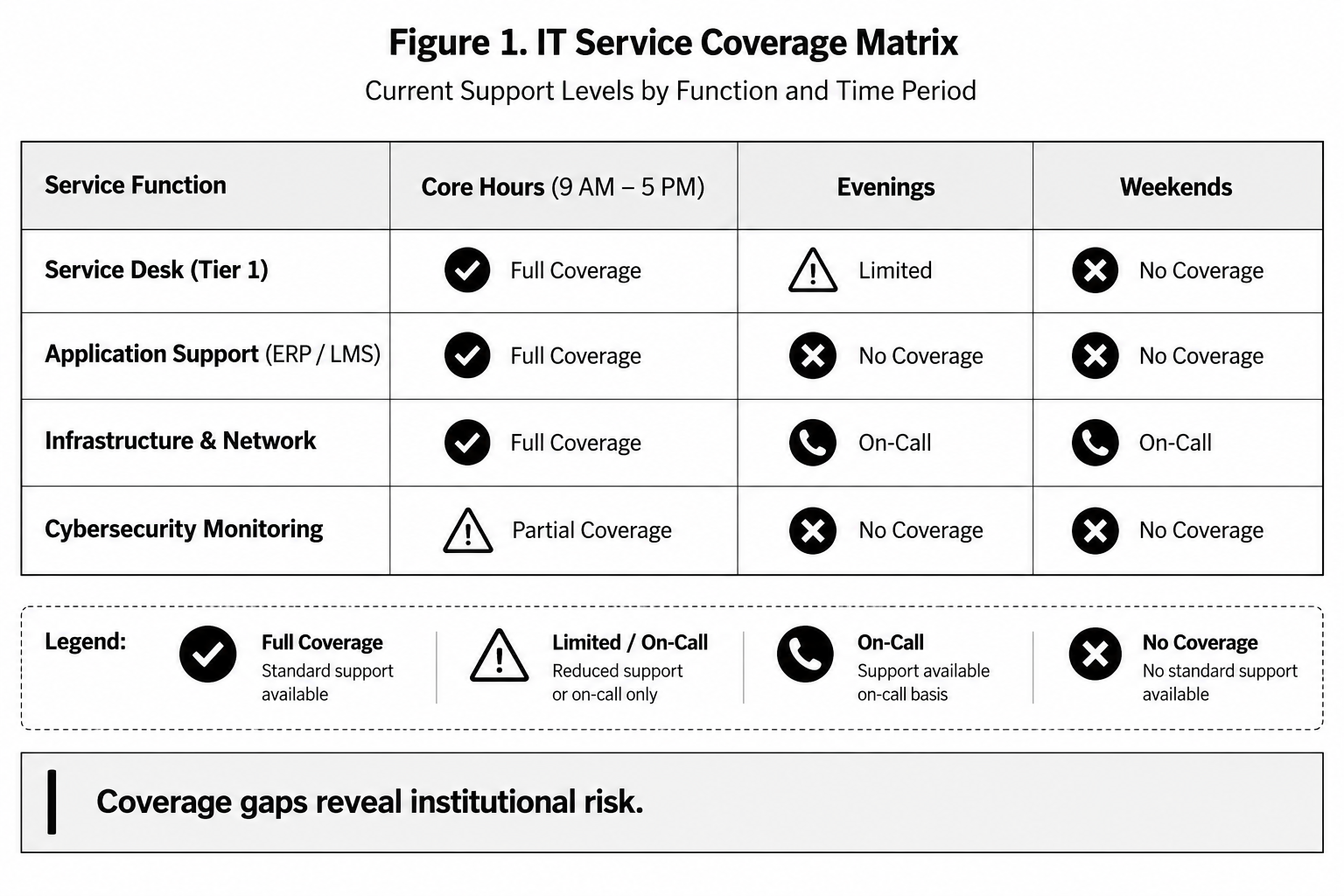
When leaders see this, the reaction is rarely defensive. It's usually surprise.
Many organizations believe they operate "24/7 systems." What they actually fund is 9–5 coverage supporting 24/7 expectations.
That gap is where risk quietly accumulates.
Coverage alone isn't the full story
Coverage tells you when someone is available. It doesn't tell you how resilient the function actually is.
Two services can show identical coverage and represent very different levels of institutional risk. The difference usually comes down to maturity and staffing depth.
Once coverage is visible, the next step is understanding whether the service survives stress, absence, and incidents.
Adding maturity and staffing depth (current-state realism)
To extend the coverage view, I add two lenses calibrated to how things actually operate today—not how they appear in plans or org charts.
Operational maturity scale
- Absent No formal ownership. Work happens ad hoc, through workarounds or heroics—or not at all.
- Fragile The function exists but is person-dependent. Knowledge is tribal. Failure equals disruption.
- Functional The function is defined and repeatable under normal conditions, but struggles under stress, absence, or peak demand.
- Resilient The function is documented, governed, monitored, and transferable. It survives incidents, turnover, and change.
This is not a judgment scale. It's a survivability scale.
Staffing depth indicator
Rather than abstract FTE math, staffing depth is described operationally:
- 0 — No one formally performs this function
- 1 — Single point of failure
- 2 — Partial redundancy (still brittle)
- 3+ — Sustainable, transferable capability
This is often where risk becomes undeniable.
An expanded example: Enterprise Applications
Below is a hypothetical—but realistic—current-state snapshot for an under-resourced Enterprise Applications team. It combines coverage, maturity, and staffing depth.
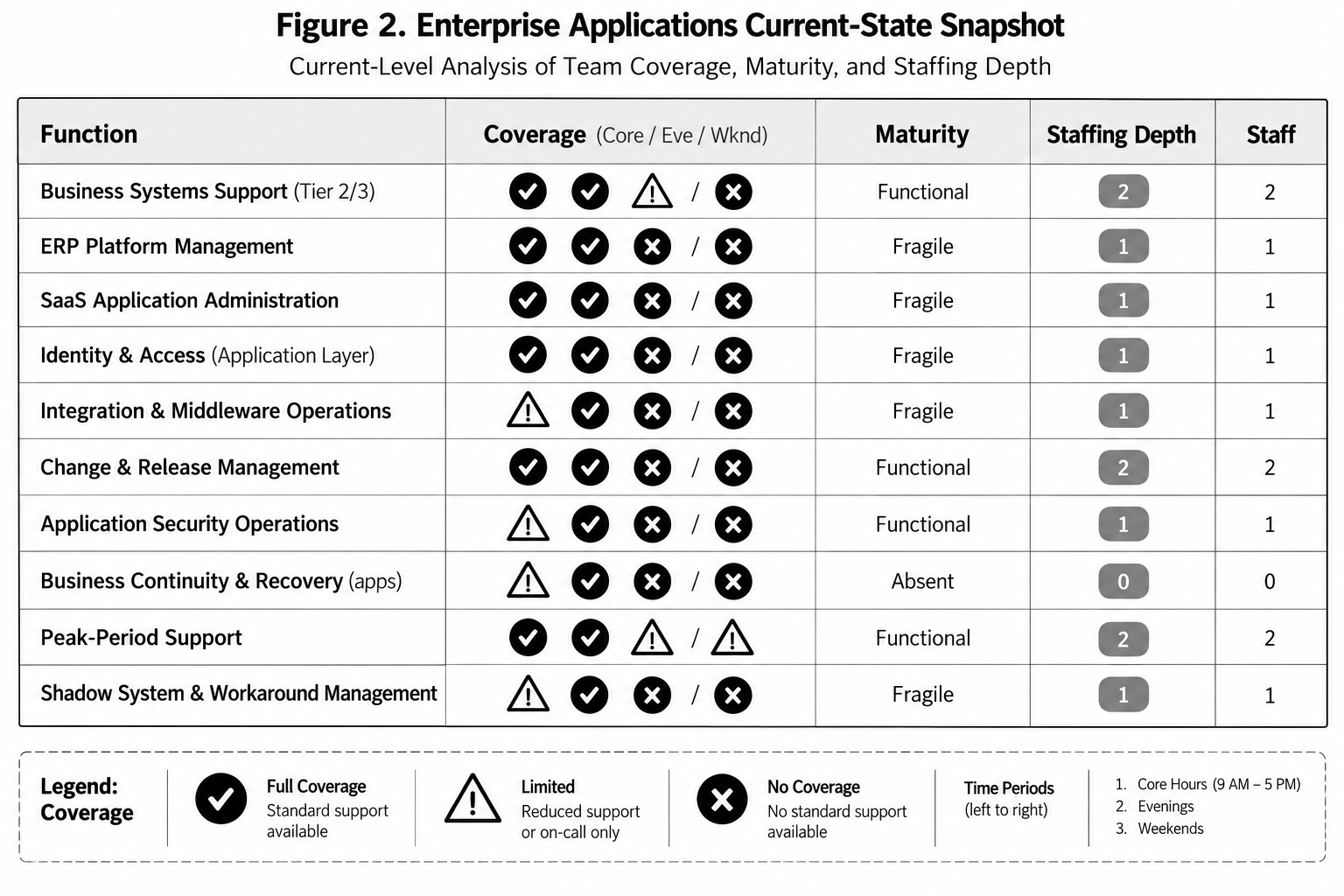
The shift isn't from fragile to resilient. It's from person-dependent to operationally repeatable.
That distinction matters.
What this doesn't do
One additional role does not:
- Create true 24/7 coverage
- Eliminate weekend gaps
- Remove all risk
Those outcomes require deliberate structural investment.
What this model does provide is clarity: leaders can now see which risks are reduced, which remain, and what further investment would be required to move from functional to resilient.
Why this matters during budget season
This reframing changes the tone of funding discussions.
Instead of:
"IT needs more people."
The conversation becomes:
- Which functions are fragile by design?
- Where are we accepting single points of failure?
- Which risks are we consciously choosing to carry?
That's not an IT complaint. That's governance.
Bringing it back to capacity
This is why capacity can't be reduced to effort or utilization.
Real capacity is shaped by:
- When services are covered
- How mature those services are
- How concentrated the capability is
Until all three are visible, budget decisions are made with incomplete information.
Closing reflection
The most productive capacity conversations don't start with numbers. They start with maps—and mature into honest conversations about resilience.
That's when IT stops being a black box and becomes what it really is: a core operational system.
How Northline Advisory can help
Northline Advisory works with organizations that need a clear, defensible view of IT capacity, operational risk, and staffing resilience—particularly during periods of budget pressure, growth, or increased service expectations.
This work replaces assumption-based capacity debates with evidence leaders can act on.
Engagement deliverables typically include:
- IT service coverage mapping Visual representation of when services are actually supported across core hours, evenings, and weekends.
- Operational maturity assessment Current-state evaluation of critical IT functions using a practical scale (Absent, Fragile, Functional, Resilient).
- Staffing depth and dependency analysis Identification of single points of failure and areas of concentrated risk.
- Risk-based executive insights Plain-language articulation of operational and continuity risks tied to current coverage and maturity levels.
- Targeted staffing scenarios Practical "before and after" views showing what specific staffing investments would—and would not—change.
- Executive-ready summaries Board- and leadership-level materials suitable for budget submissions and planning discussions.
Scope, timelines, and depth of analysis are tailored to the size and complexity of each organization, with a consistent focus on enabling informed, risk-aware decisions—not selling headcount.
If your organization would benefit from greater clarity on IT capacity and resilience, I'm available to discuss how this approach could be applied in your context.
Originally published on LinkedIn on January 20, 2026.
Steven Boyle is the founder of Northline Advisory, a technology advisory and research practice focused on technology leadership, enterprise transformation, governance, data and governed AI. His work draws on more than two decades of executive and operational experience across higher education and public-interest organizations.