
Research Paper · Data & AI
Beyond the Model
A Governed Architecture for Consequential AI Systems
Consequential AI requires an architecture that governs evidence, artifacts, evaluation, authority and learning around the model.
How we connected research publishing, persistent identifiers and software release controls at Northline Advisory.
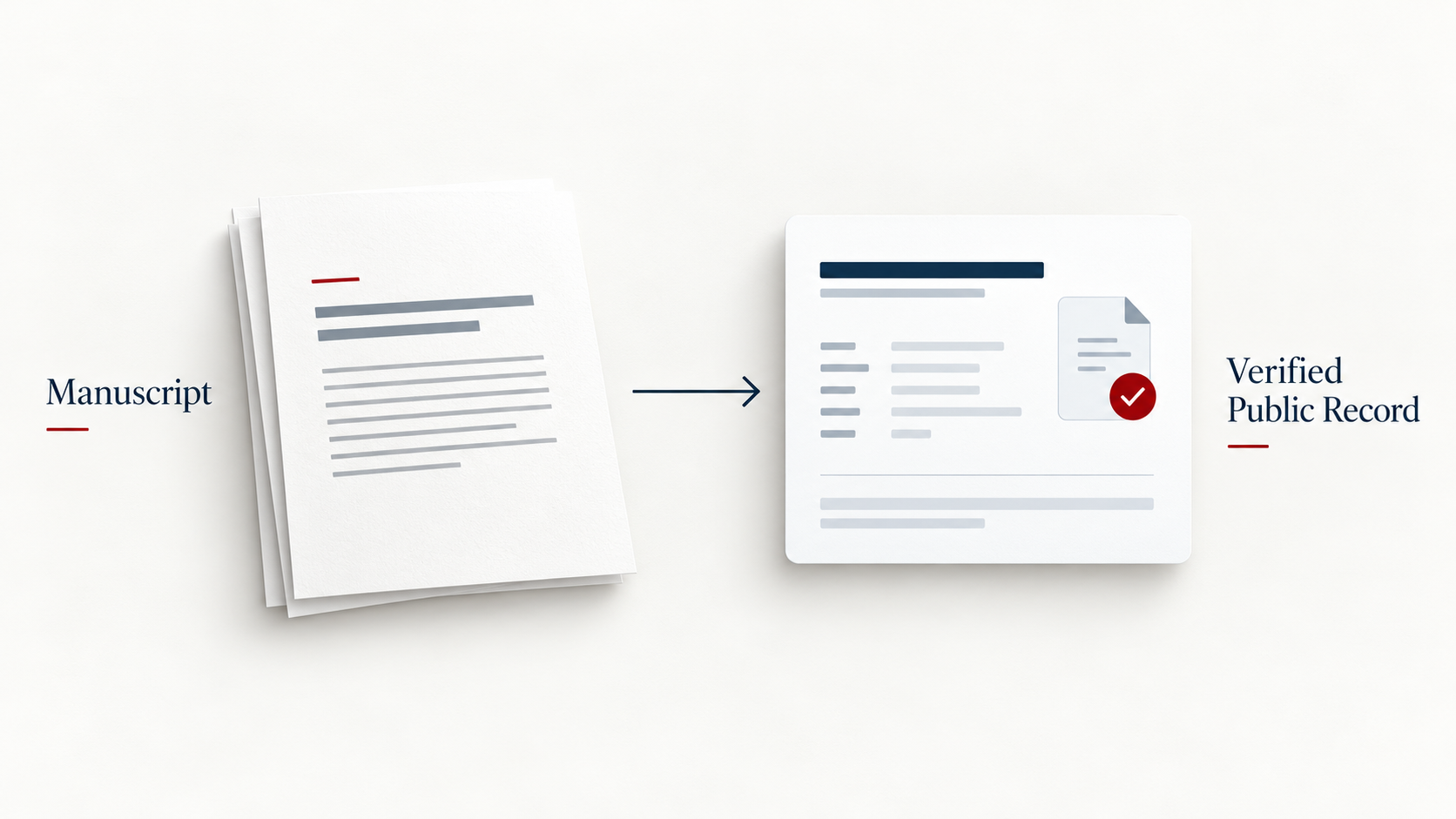
Publishing a research paper on a website is straightforward. Making sure people can find it, cite it, identify its author and know which version they are reading takes more work.
We encountered this while establishing the research publishing process at Northline Advisory. We had developed formal Research Papers and shorter Research Notes, with defined requirements for evidence, references, disclosures and editorial approval. Our website could present the work, but the website alone did not provide everything we needed for a dependable publication record.
We wanted our research to be available beyond Northline's immediate professional network. We also wanted to ensure that the published manuscript, the website information and the permanent research record remained consistent.
That led us to connect several established research services with our existing website development and release process. The resulting system is now operating in production.
The work exposed five practical problems that other independent researchers and small organizations may recognize.
A paper posted on a company website can be read and shared. But someone who finds it may have difficulty determining how to cite it, whether it is the latest version, or how it relates to other work by the same author.
A website address is also not a particularly dependable research identifier. Pages move, websites are redesigned and organizations change their content structures.
We wanted Northline's research to have a more persistent identity, independent of the particular webpage used to present it.
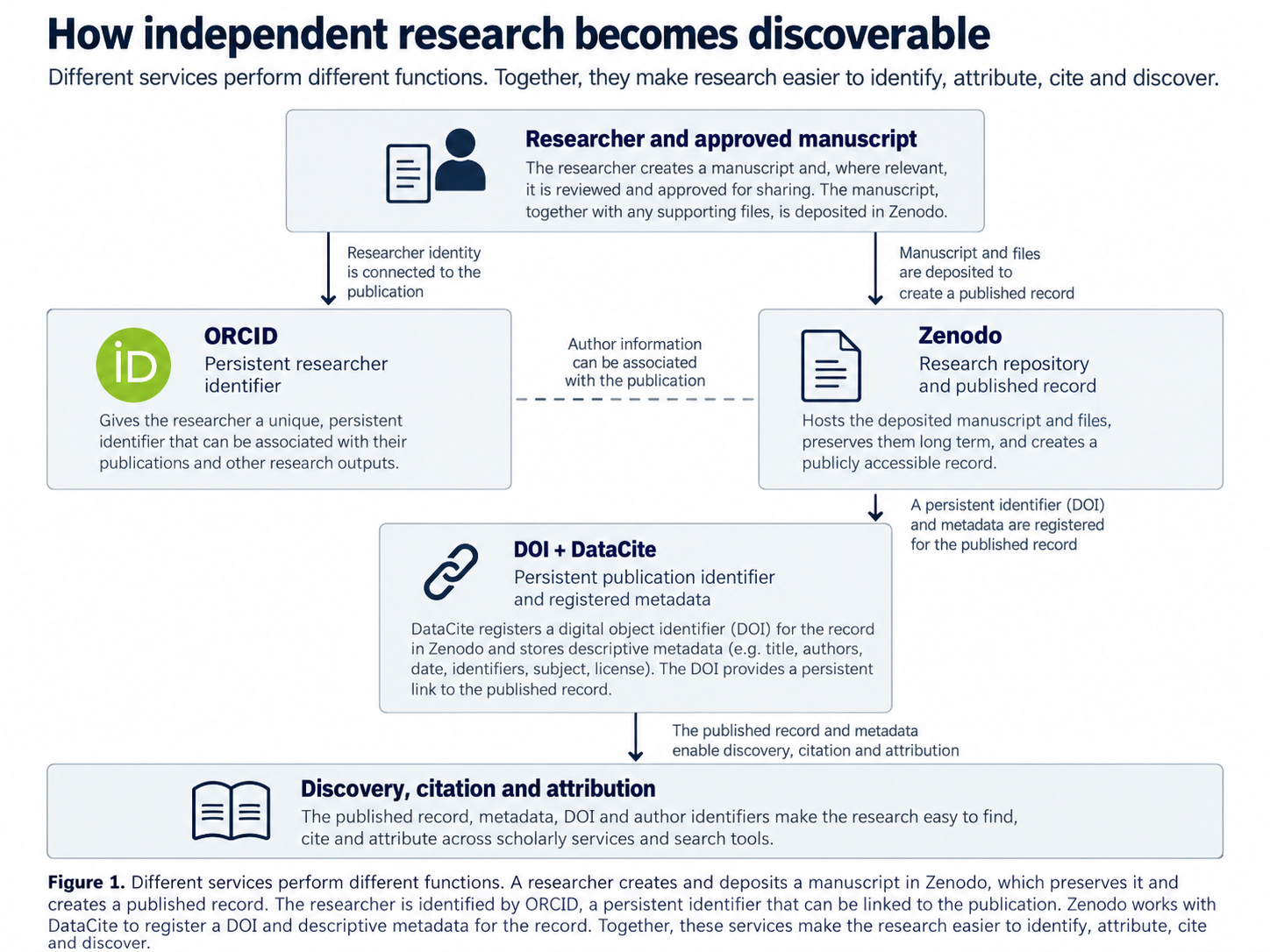
We selected Zenodo, a general-purpose research repository operated by CERN. Zenodo allows researchers to deposit papers and other research outputs, including work produced independently of universities and traditional academic publishers.
This matters because the public record of a paper no longer depends exclusively on maintaining our own website. The manuscript can be found and referenced through a separate research repository.
Zenodo is not a substitute for peer review. Depositing a paper establishes a public research record; it does not establish that the research has been independently validated.
When Zenodo publishes a research record, it assigns a Digital Object Identifier, or DOI.
A DOI is more than a shortened web address. It is a persistent identifier associated with a registered publication record. The DOI can continue to identify the work even when the web location associated with it changes.
For Northline, this means readers can cite a paper using an established research identifier rather than depending on a company webpage.
Zenodo also distinguishes between the DOI for a particular published version and a concept DOI that connects the publication's versions. This distinction becomes important when a paper is subsequently revised.
A publication also needs a dependable connection to the person who created it.
ORCID provides researchers with persistent personal identifiers. An ORCID remains associated with a researcher even if they change employers or affiliations.
DataCite registers research DOIs and makes their metadata available to other services. Its ORCID integration can help associate newly registered research outputs with the author's ORCID record.
For an independent researcher, these services matter because the work can be attributed and discovered beyond the organization that originally published it.
None of this guarantees that a paper will be read or cited. It provides the infrastructure that makes discovery, identification and citation more dependable.
Once we understood how the services fitted together, another problem became apparent: Northline and Zenodo would each hold information about the same research publication.
Northline would retain the approved manuscript, publication classification, website presentation and authoritative metadata. Zenodo would maintain the deposited research record, DOI identifiers and uploaded manuscript.
If the two systems were maintained independently, differences could accumulate.
We identified five practical risks.
| Problem | Northline's response |
|---|---|
| A research paper goes live without a permanent citation | Production release checks require the publication's Zenodo DOI and record information. |
| Website and repository metadata become inconsistent | Publication records include identifiers, version information, synchronization status and a verification date. |
| Website deployment unintentionally publishes research to Zenodo | Publication authority is kept separate from ordinary website builds. |
| Incorrect or incomplete information enters production | Automated validation and regression tests check the publication package and release conditions. |
| Published manuscripts or records diverge | Comparison, explicit discrepancy reporting and controlled publication versioning. |
These decisions shaped the system we eventually implemented.
We established one structured publication catalogue within Northline's website repository.
For each Research Paper or Research Note, that catalogue records the information needed to identify and publish the work. It includes the title, authors, abstract, publication date, version, references, publication classification, DOI identifiers and location of the approved PDF.
It also records a cryptographic fingerprint of the approved manuscript. A fingerprint is a value calculated from a file's contents. If the file changes, the fingerprint will ordinarily change as well.
This provides an important control: the system can verify that the PDF being processed is the same file that was approved.
A separate integration translates the Northline record into the information Zenodo requires. Research Papers and Research Notes can therefore use the same publication workflow while retaining their distinct classifications.
The system does not regenerate or rewrite an approved manuscript during publication. The approved document remains the source.
We also used Git, the version-control system underlying our GitHub repository, to maintain a history of changes to Northline's research publication information.
Git records changes to files and identifies each committed version of the repository. This allows us to establish which manuscript and publication metadata were present when a particular release was prepared and approved.
For Zenodo publication, we went further. Approval is tied to a specific Git commit, the Zenodo deposit, and digital fingerprints of the manuscript and metadata. If those inputs change after approval, the publication operation is refused.
This matters because approval should apply to the material someone actually reviewed, not to whatever happens to be present when the publication process runs.
Git does not establish that research is scientifically valid. Its contribution is to make changes traceable and help ensure that publication decisions remain connected to identifiable versions of the material.
Northline's website is maintained through GitHub and deployed using Vercel. Those tools are suitable for controlling website changes, but ordinary website deployment should not also have authority to publish permanent research records.
We deliberately separated those responsibilities.
The Zenodo workflow can prepare a draft, upload an approved manuscript, compare the result against the Northline record and support publication following explicit authorization.
Before production publication, the approval is tied to the specific manuscript, metadata, Zenodo deposit and source-code version being reviewed. If those inputs change, the authorization no longer matches.
Publication also requires a separate credential and deliberate confirmation.
By contrast, a normal website build has no Zenodo publication authority. It checks the locally recorded publication state, runs the required tests and produces the website only when the publication requirements are satisfied.
This distinction matters because publishing a permanent research record is a more consequential action than updating a webpage.
A corrected heading on the Northline website should not accidentally create a new Zenodo publication.
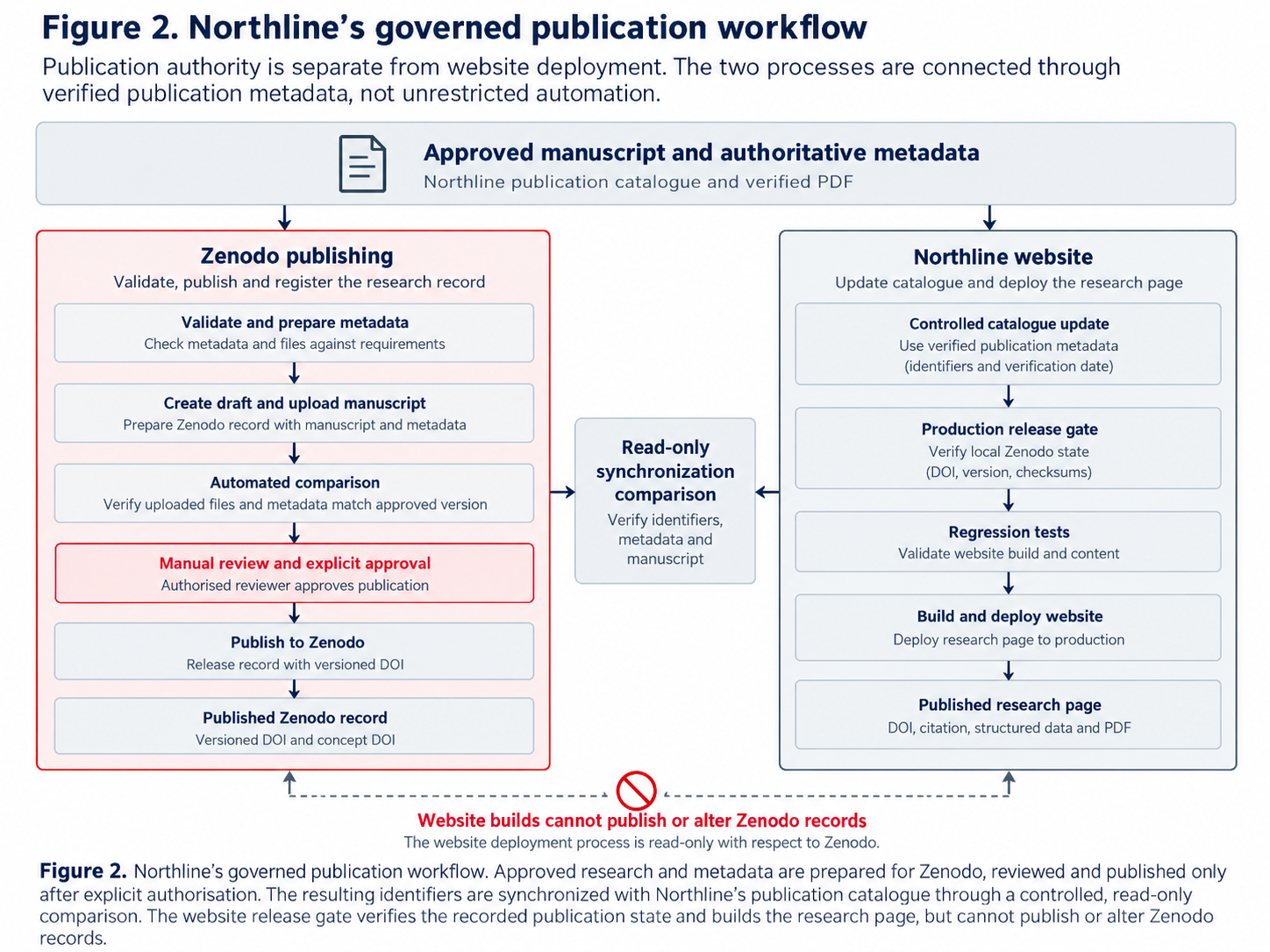
The release process requires a Research Paper or Research Note to have complete publication information, a locally verified approved PDF and the appropriate Zenodo identifiers before it can enter production.
It checks the DOI, Zenodo record and concept identifiers, canonical record address, publication status and verification date. It also checks that identifiers are not duplicated across the catalogue.
The build does not contact Zenodo to recheck the remote record every time. Instead, remote comparison is a separate controlled operation, and the website build validates the recorded local state.
That is an important distinction. The release gate enforces the approved synchronization state; it is not a continuous monitoring service.
In the current implementation, 17 Zenodo regression tests pass. A subsequent verification also confirmed that the production release gate passed for nine Research publications, with one documented exception.
These tests establish that the implemented validation and control mechanisms behave as expected in the tested cases. They do not replace manual review of the manuscript, publication metadata or live Zenodo deposits.
The exception is instructive.
Our EPS Research Note was published on Zenodo before the current publication controls were fully established. When we compared the Zenodo record with Northline's authoritative publication catalogue, the system identified several differences.
These included publication metadata, keywords, notes and the expected manuscript filename.
Because the expected filename was not present in the remote record, the normal file-checksum comparison could not be completed. We therefore know the records are inconsistent, but that particular comparison does not establish whether the actual PDF contents differ.
The system records the publication as published with drift—meaning the local and repository records have not been fully reconciled.
We chose not to correct the published record automatically. The release gate allows this one explicitly identified legacy exception and reports it as a warning.
This is a deliberate compromise. It allows unrelated website work to continue while keeping the discrepancy visible.
Resolving it requires a decision about the authoritative manuscript and metadata. If a new Zenodo version is needed, that version must pass the same approval and publication controls as a new paper.
The important lesson is not that a system should never encounter inconsistent records. It is that inconsistencies should be visible and should not be resolved by silently changing published research.
Northline's process has several moving parts because we publish different kinds of research through a website with an established software delivery workflow.
Someone publishing an occasional paper does not need to reproduce all of that infrastructure.
A practical starting point is much simpler:
For someone publishing regularly, additional controls become useful.
A structured catalogue reduces repeated data entry. File fingerprints help detect unapproved document changes. Automated validation identifies missing information before publication. Separate publishing permissions protect permanent research records from routine website operations.
An organization does not necessarily need Northline's exact technology stack to adopt these practices. What matters is maintaining a clear source of authority and identifying which actions require a deliberate decision.
We initially needed a practical way to make Northline's research easier to find and cite. Zenodo, DOI registration and ORCID provided much of the necessary infrastructure.
The additional engineering work arose from a different requirement: ensuring that what we published remained consistent across systems, and that ordinary software operations could not alter permanent research records without authorization.
The implementation now supports that requirement through a structured publication catalogue, explicit approval, automated checks and controlled versioning. It also retains a documented exception that still needs resolution.
For independent researchers, the underlying publishing services are accessible without building such a system. For organizations producing research repeatedly, however, connecting those services through explicit publication controls can reduce avoidable errors and make responsibility for the public record much clearer.
The central decision is straightforward: the approved research should determine what is published, and the publication process should preserve that decision rather than quietly making new ones.
Steven Boyle is the founder of Northline Advisory, a technology advisory and research practice focused on technology leadership, enterprise transformation, governance, data and governed AI. His work draws on more than two decades of executive and operational experience across higher education and public-interest organizations.
A Governed Architecture for Consequential AI Systems
Consequential AI requires an architecture that governs evidence, artifacts, evaluation, authority and learning around the model.
Governing State, Authority and Lineage
An implemented architecture for treating durable, versioned and governed artifacts—not transient model responses—as the unit of enterprise AI control.
Knowing What Supports a Conclusion
A deterministic evidence architecture for preserving and inspecting the governed relationships that actually support AI-generated conclusions.