

Technology Readiness Is Becoming Mission Readiness
AI, cybersecurity, modernization and digital service are often treated as separate priorities. In practice, they are testing the same thing: whether the organization can absorb and sustain technology-enabled change.
Many public-serving and mission-driven organizations are under pressure to move faster.
Adopt AI. Improve digital services. Strengthen cybersecurity. Make better use of data. Modernize aging systems. Reduce manual work. Improve service while controlling cost.
Each priority makes sense. The problem is that they are often treated as separate initiatives when they are really testing the same thing:
Is the organization ready to absorb and sustain technology-enabled change?
Not ready in the sense of having a strategy document or a list of projects. Ready in the practical sense: clear services, reliable systems, usable data, visible capacity, understood risk, and governance that helps people make decisions when priorities collide.
This is where the conversation about technology leadership needs to become more practical.
For years, organizations have talked about moving IT from the sidelines to the strategy table. That still matters, but it is not the real test anymore. The real test is whether technology is involved early enough to help the organization make better decisions about service, risk, capacity, data, and change.
I have seen technology teams work incredibly hard and still be treated mainly as a response function. Tickets are closed. Systems are maintained. Projects move forward. People are committed.
But the organization continues to struggle with unclear priorities, fragmented data, manual workarounds, aging platforms, inconsistent service experience, and decisions made before the technology implications are understood.
That is usually not a talent problem. It is an operating model problem.
Technology has been placed too far away from planning, then asked to deliver once the decisions are already made.
That model is becoming harder to sustain.
AI exposes weaknesses in data, privacy, workflow design, governance, and trust. Cybersecurity exposes weaknesses in resilience, asset visibility, vendor management, and operational continuity. Digital service expectations expose weaknesses in process design and service ownership. Legacy systems expose years of deferred decisions. Capacity pressure exposes the gap between ambition and what teams can responsibly deliver.
The practical question for leaders is not, "Do we have enough technology projects?"
It is, "Are we building the conditions that allow technology to support the mission reliably?"
I would start with six questions.
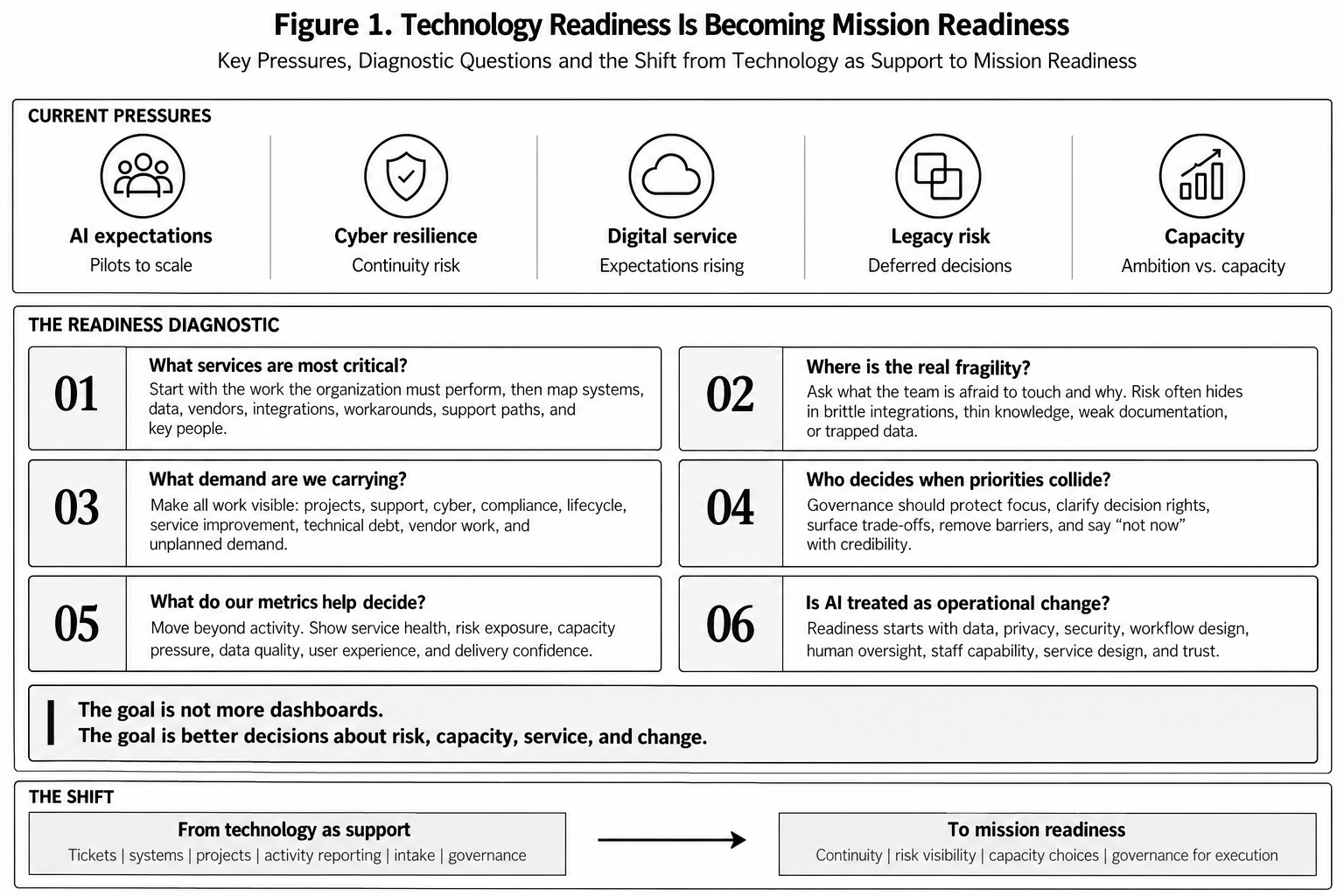
1. What services are most critical?
Start with the work the organization must be able to perform, not the application inventory.
Which services matter most to the people the organization serves? Which internal services enable those outcomes? Which ones would create the greatest operational, reputational, financial, or trust risk if they failed?
Then map what sits underneath: systems, data, vendors, integrations, manual workarounds, support paths, security controls, and people with specialized knowledge.
This often changes the conversation. A system that looks ordinary on an asset list may be supporting a critical service. A small integration may be carrying a major operational dependency. A manual workaround may be hiding a risk no dashboard currently shows.
2. Where is the real fragility?
Legacy risk is not only about age.
A system becomes fragile when few people understand it, changes are difficult, documentation is weak, integrations are brittle, vendors are hard to manage, data is difficult to extract, or failure would disrupt important work.
In my experience, leaders often know the major modernization projects. They may not always see the fragile points that teams quietly manage every day.
A useful question is: what are we afraid to touch, and why?
The answer often reveals more than a lifecycle spreadsheet.
3. What demand are we already carrying?
Most organizations underestimate technology demand.
The visible portfolio may include approved projects, but the real portfolio also includes operational support, cybersecurity improvements, compliance work, data requests, vendor changes, lifecycle replacement, service improvements, technical debt, and unplanned work.
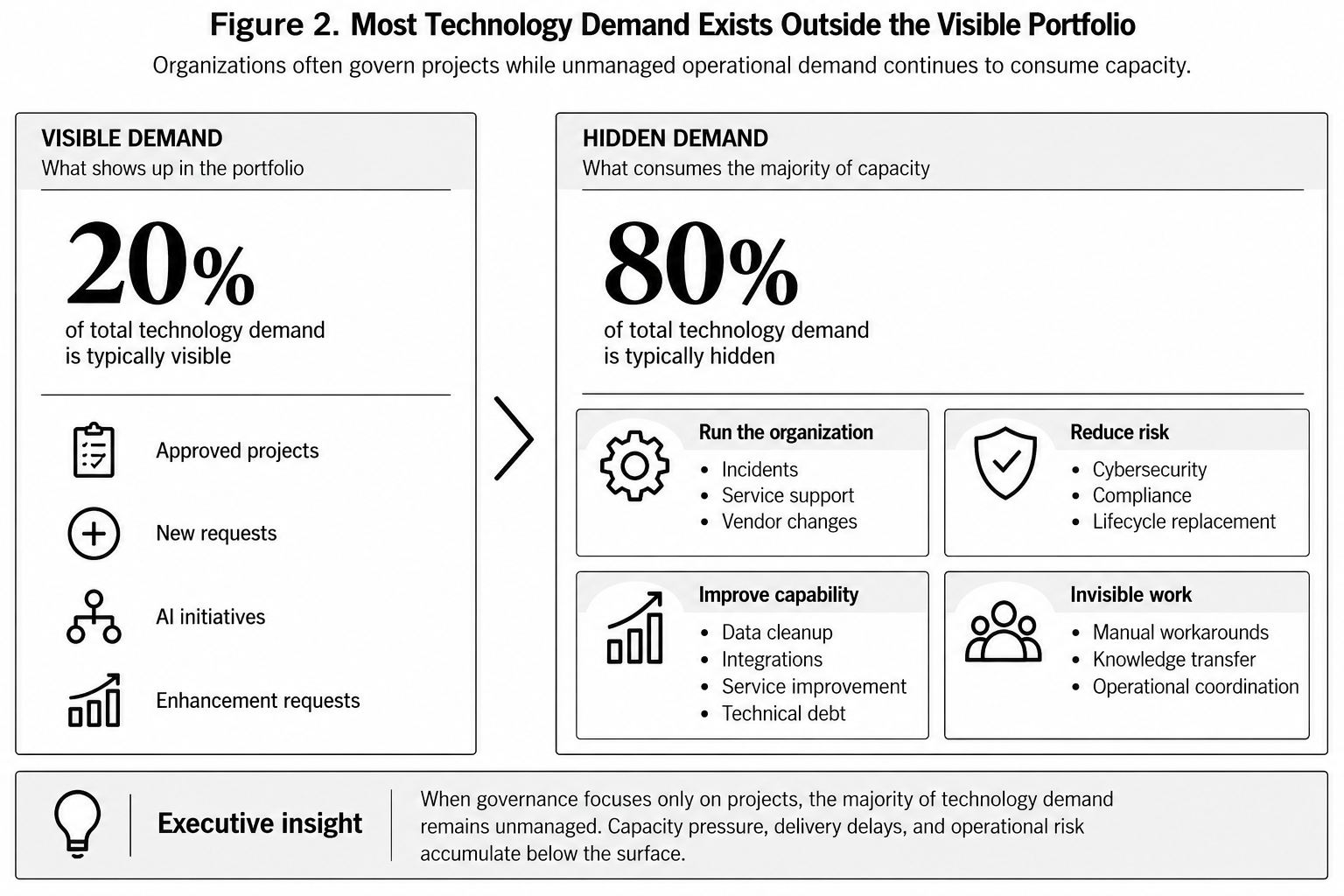
If total demand is not visible, trade-offs still happen. They just happen informally.
Teams absorb pressure. Timelines stretch. Quality drops. Risk accumulates. Everything feels urgent because the full set of choices has not been made explicit.
A better capacity conversation is not simply, "Do we need more people?"
It is, "What are we choosing to do, what are we choosing not to do, and what risk are we accepting?"
4. Who decides when priorities collide?
Governance is often mistaken for intake.
Requests come in. Committees review them. Projects are ranked. Approvals are given.
That may create order, but it does not necessarily create execution.
Good governance should clarify decision rights, surface trade-offs, connect work to priorities, remove barriers, and maintain accountability after approval. It should help leaders decide when two good things cannot both happen at the same time.
A simple test: can the governance process say "not now" with credibility?
If every priority remains a priority, governance is not protecting focus.
5. What do our metrics help leaders decide?
Ticket counts, uptime, project status, and budget tracking all matter. But they are incomplete.
They tell leaders whether activity is happening. They do not always show whether the organization is becoming more resilient, more capable, or better aligned to its mission.
Technology reporting should help leaders see service health, risk exposure, capacity pressure, aging systems, data quality, user experience, delivery confidence, and progress against meaningful outcomes.
The goal is not more dashboards. The goal is better decisions.
6. Are AI and automation being treated as operational change?
AI readiness does not start with the tool.
It starts with data quality, privacy, security, process clarity, human oversight, staff capability, service design, and trust.
Without those foundations, automation can make weak processes move faster, spread poor data further, and create accountability questions the organization has not yet answered.
This is why service management matters. Not as a rigid framework, but as a discipline for making services clear, reliable, measurable, and continuously improved.
It is also why technology cannot remain only a support function. Support is essential. Reliability is essential. Responsiveness is essential.
But in today's environment, technology teams also need to help the organization understand how systems, data, process, people, risk, and service fit together.
For mission-driven organizations, technology is no longer beside the work. It is embedded in how people serve, decide, respond, and adapt.
Technology readiness is becoming mission readiness.
The organizations that adapt best will not simply be the ones with the newest tools or the longest project lists. They will be the ones that do the practical work well: clarify services, make risk visible, modernize fragile systems, strengthen governance, understand capacity, improve data discipline, and connect technology planning to the outcomes that matter most.
The next stage of technology leadership is not moving away from support.
It is building on that foundation so technology becomes part of how the organization plans, prioritizes, operates, and delivers.
Originally published on LinkedIn on June 11, 2026.
Steven Boyle is the founder of Northline Advisory, a technology advisory and research practice focused on technology leadership, enterprise transformation, governance, data and governed AI. His work draws on more than two decades of executive and operational experience across higher education and public-interest organizations.