Millions of people now use artificial intelligence to do far more than ask questions. They develop business ideas, write articles, conduct research, organize projects, analyze information and solve problems. Some build increasingly sophisticated workflows, complete with specialized instructions, reusable knowledge and automated tasks, without ever thinking of themselves as developing a system.
Yet that is often exactly what they are doing.
A conversation that begins with a simple question can evolve into weeks of work. Information is gathered, ideas are refined, decisions are made and documents are revised. Over time, the AI becomes familiar with the subject, the user's preferences and the direction of the work. What began as a conversation gradually becomes a working environment.
The difficulty is that conversations are not necessarily good places to manage everything that environment produces.
Important decisions can become buried in earlier discussions. Documents may exist in several versions. Instructions that worked well last month may have been revised without a clear record of what changed. A new conversation may recover some of the context but not the precise state of the work.
AI memory can help maintain continuity, but memory is not the same as a dependable record. It may retain useful facts and preferences without preserving every decision, document revision or dependency. Nor does remembering something establish that it remains correct or authoritative.
This is where a tool called Git becomes interesting.
Git was originally developed to help software developers manage changes to their code. At its simplest, it is a system for keeping track of files and how they change over time. Rather than repeatedly saving documents as final, final revised and final version 3, Git can maintain a history of changes, show what was modified and make earlier versions available when needed.
The files do not have to contain software. They can hold research notes, articles, operating procedures, project plans, AI instructions, structured knowledge and other material that develops through repeated revision.
GitHub, a popular platform built around Git, makes those repositories easier to store, access, review and share. You do not need to be a programmer to benefit from the underlying approach, although some initial setup and a basic understanding of how changes are recorded are useful.
Think of it as giving your AI-assisted work a more dependable foundation.
A conversation remains useful for exploring ideas, asking questions and deciding what to do next. A well-organized repository provides a place for important work to persist beyond that conversation. Git records how the managed files evolve, making it possible to examine previous versions, understand changes and recover earlier material.
A chat has context. Git has history.
There is another important distinction. Git is not itself an AI memory system, a search engine or a knowledge base that automatically understands everything it contains. But when combined with clear organization, useful documentation and appropriate AI tools, it can support all three.
An AI assistant with access to the relevant repository can retrieve established instructions, consult existing work, compare revisions and continue from recorded artifacts rather than reconstructing everything from conversation history. Important knowledge can become reusable across sessions, projects and, where access is permitted, different people or AI assistants.
The history also creates opportunities for learning. By examining earlier approaches, accepted changes and unsuccessful experiments, people can understand how their work evolved and apply those lessons to future decisions. An AI system can be designed to use that history as evidence for improving subsequent work, rather than merely repeating whatever it last discussed.
None of this requires building an elaborate technical platform. Even someone using AI casually to develop a writing project, plan a business or organize a complex personal undertaking can benefit from having a consistent place to maintain important files and their history.
The benefits become more significant as the work grows.
Once AI begins helping with multiple related activities, a dependable repository can support collaboration, controlled experimentation, clearer decisions and recovery when something goes wrong. It becomes easier to distinguish a proposed change from an accepted one, identify the current version and transfer work between conversations without losing the underlying material.
And this foundation becomes particularly powerful when moving toward more advanced forms of AI.
Imagine delegating a substantial objective to an assistant that can plan the work, assign tasks to specialized AI skills, coordinate external tools and return completed results. Several capabilities may contribute to the same objective, sometimes across different sessions and systems.
For that arrangement to work reliably, the participants need more than conversational context. They need access to the appropriate instructions, knowledge, current artifacts and records of what has already been done. They also need to know which changes have been accepted, what remains unfinished and where human approval is required.
A properly organized, version-controlled repository can become an important part of that shared foundation.
This is the progression I want to explore: from using Git to preserve a few useful documents, to building a durable knowledge and working environment, to supporting governed delegation across increasingly capable AI systems.
The starting point is surprisingly simple. You do not need to write code to benefit from Git. You need work that matters enough to preserve, understand and build upon.
When a conversation becomes a working system
Consider someone developing a new business with the assistance of AI. They begin by exploring an idea, then work through the market, services, financial assumptions, customer needs and operating requirements. As the project develops, they create documents, revise decisions and establish instructions for how the AI should help with recurring activities.
At first, the conversations provide enough continuity. The person knows what they have been working on and can usually find the information they need. As the material accumulates, however, the relationship between the different pieces of work becomes harder to manage.
A financial assumption may change without being reflected in the business plan. An earlier discussion may contain the reasoning behind a decision, while the current document records only the result. Several versions of a proposal may exist, with no clear indication of which one should be used.
I have encountered variations of this problem while developing AI-assisted engineering, research and publication workflows. The work itself may be progressing, but the information needed to continue it is distributed across conversations, files, instructions and working records. An assistant can produce a plausible account of what happened without necessarily identifying the exact artifact that was changed or the version that was accepted.
The issue becomes particularly apparent when work passes from one session or capability to another. Context that was obvious during the original activity may no longer be available, and reconstructing it can consume time that should have been spent advancing the work.
This is where I find the concept of a repository useful, even for work that has nothing to do with programming.
A repository is a defined collection of files maintained together. In Git, those files can be placed under version control so that their recorded changes form a history. The current documents remain accessible, while earlier versions and the differences between them can be examined when necessary.
For a business project, that might mean maintaining the current plan, supporting research, assumptions, decisions and instructions in one organized location. The AI can use those materials as references, while Git records the changes made to them.
This does not eliminate the need for judgment or organization. It does reduce dependence on the ability of a conversation to reconstruct the state of the work.
There is also a practical benefit for people who use several AI tools. A properly maintained repository can provide common reference material without requiring every assistant to share the same conversational memory. Access still needs to be configured, and the tools must be instructed to use the repository appropriately, but the underlying information is no longer tied to one conversation.
Preserving knowledge is only part of the problem
It would be easy to conclude that the answer is simply to put everything into Git. My experience suggests that this would reproduce a familiar organizational problem in a different location.
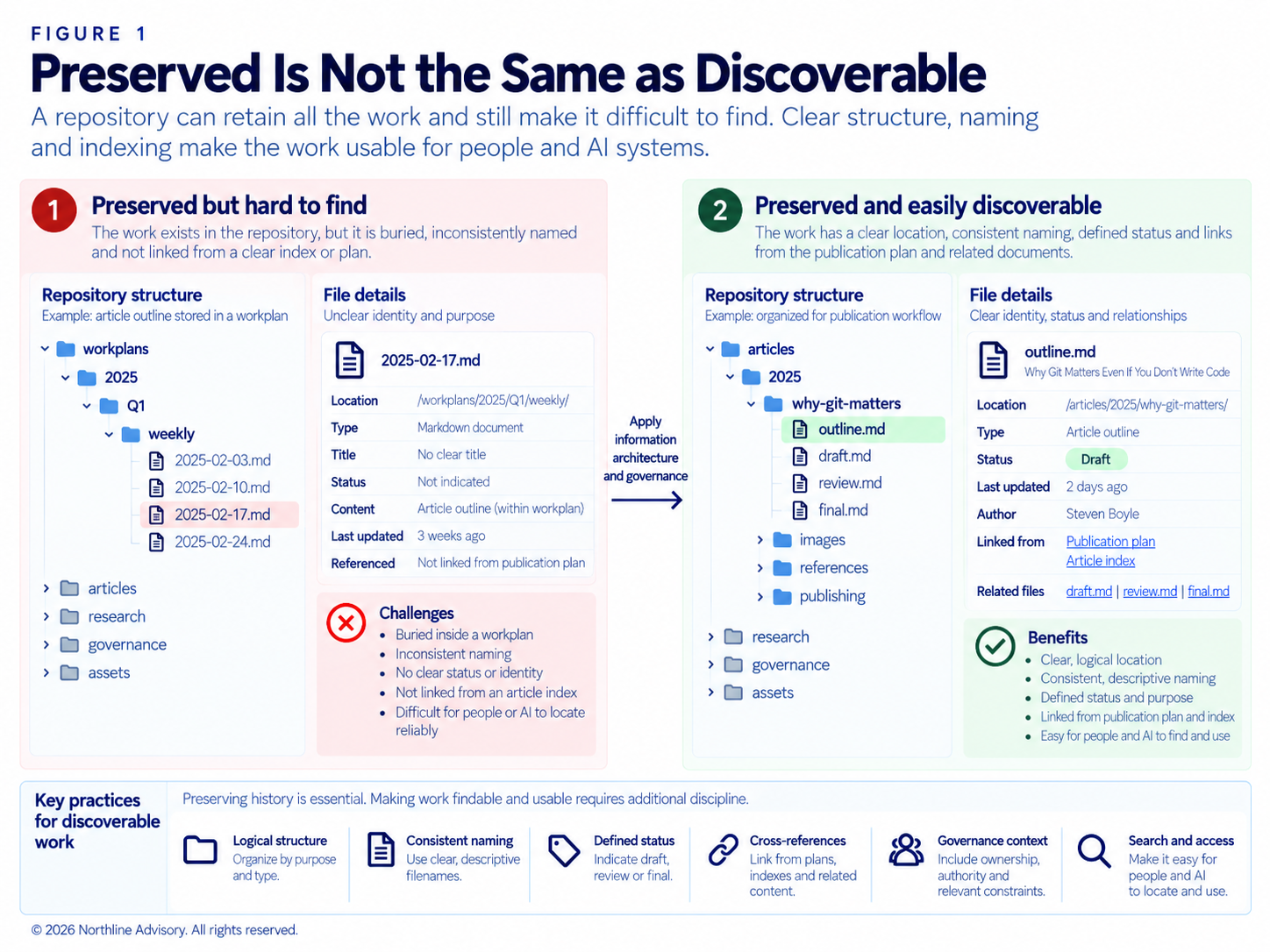
A repository can preserve files accurately while remaining difficult to navigate. Documents may have ambiguous names, related material may be scattered across directories, and a workplan may refer to an artifact without identifying where the authoritative version resides.
I recently encountered this while trying to recover an article outline that had been developed as part of an existing publication workflow. The work had been referenced in a plan, but locating the actual source required considerably more investigation than it should have. The problem was not necessarily a failure to save information. It was the absence of a sufficiently clear relationship between the planned activity and the artifact needed to carry it forward.
That experience illustrates a limitation worth understanding before adopting Git more broadly.
Version history tells us how managed files changed. It does not automatically tell us which file is relevant to a particular objective, whether a document has been superseded or what authority it carries within a larger process.
Those questions require some deliberate information architecture.
A publication workflow, for example, benefits from having a recognizable source manuscript, a defined status, an identifiable approved version and a relationship to the plan that governs its preparation. A research project needs similar clarity around its evidence, working analysis and conclusions.
Figure 1. Version control preserves the history of managed artifacts, but discoverability depends on how those artifacts are organized and identified. Clear naming, status and relationships allow people and AI systems to locate the correct information without reconstructing its context.
The amount of structure should reflect the work. A person developing a personal writing project does not need an enterprise document-management framework. A consistent directory, meaningful filenames and a short index may be sufficient.
As the work becomes more consequential or involves additional participants, the requirements increase. Information needs to be identifiable, its status needs to be understood, and important relationships should not depend entirely on one person's recollection.
These are familiar principles from information management. AI gives them renewed importance because an assistant can act on information it retrieves, including information that is incomplete or no longer current.
Where memory and learning fit
One of the more interesting aspects of working with AI is the way we use the word memory.
In ordinary conversation, remembering something suggests continuity of understanding. In an AI environment, several different mechanisms may contribute to that continuity. A model may receive previous messages, retrieve saved information, consult documents or access structured records through external tools.
These mechanisms can be useful, but they serve different purposes.
Conversational memory can help an assistant retain preferences and context. A repository can preserve documents and instructions. Git can record how managed artifacts changed. A search or retrieval capability can help locate relevant information. None of these, individually, establishes that the information is correct or that the system has learned from experience.
The distinction becomes important when people begin expecting AI to improve over time.
Suppose an assistant produces an article that requires several rounds of correction. The conversation contains feedback, but unless the relevant lessons are captured and made available to future work, another session may repeat the same problems.
One response is to revise the instructions governing the writing process. Those instructions can be maintained as files, reviewed and placed under version control. The next task can then use the updated standard rather than relying on the assistant to recall every earlier correction.
That is a practical form of improvement, although it should not be confused with retraining the underlying AI model.
The historical record can also help establish whether the revised instructions produced better results. We can examine what changed, compare subsequent outputs and decide whether the adjustment should remain in place.
In more advanced systems, this process can become systematic. Evaluations identify recurring weaknesses, proposed changes are developed, and the results are tested before being incorporated into the accepted working environment.
The value of Git here is that the changes to the managed instructions and artifacts remain visible. The evaluation process provides the evidence needed to determine whether those changes were useful.
Learning, in this operating sense, is not simply the accumulation of more information. It is the disciplined use of experience to improve subsequent work.
Managing change without losing what already works
AI makes experimentation unusually accessible. It is relatively easy to ask for an alternative approach, revise a document or attempt an improvement to an existing process.
The difficulty is knowing whether the new version is actually better.
A revised instruction may improve one type of output while weakening another. An AI-generated change to a document may remove a requirement that was not prominent in the original request. A technical modification may resolve the immediate problem while introducing an unrelated failure.
I have seen enough of these interactions in engineering work to be cautious about treating a successful generation as a successful change.
Git provides mechanisms that help separate the two.
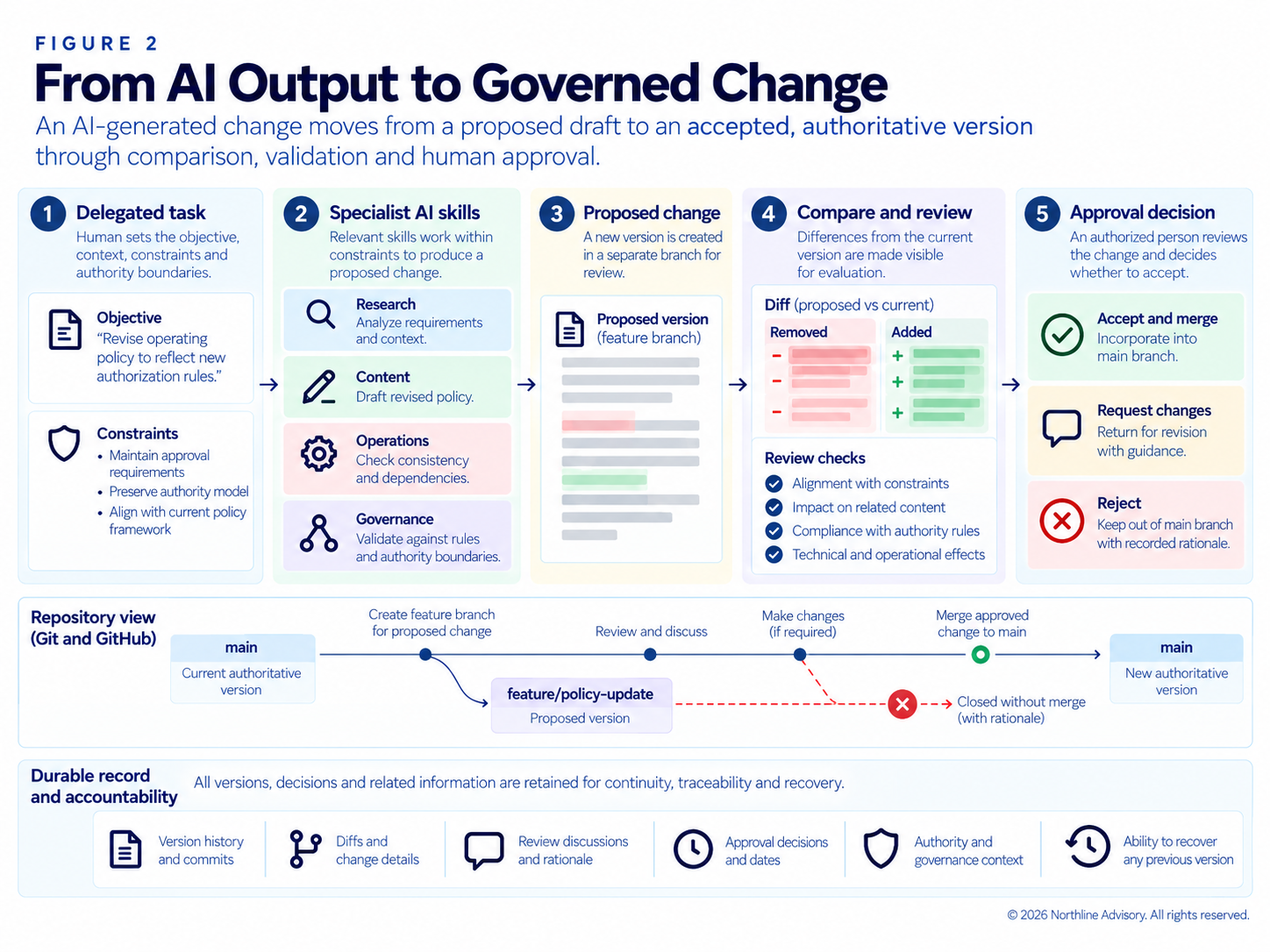
A proposed modification can be developed on a separate branch rather than immediately replacing the accepted version. A comparison, commonly called a diff, shows what was added, removed or altered. The change can be examined and tested before a decision is made to incorporate it.
For nontechnical users, the important point is not learning the terminology. It is understanding that an AI assistant can prepare a change without automatically making that change authoritative.
This is particularly useful when AI is allowed to modify persistent files. Instead of asking whether the assistant says it completed the task, the reviewer can examine what actually changed.
Figure 2. An AI-generated proposal is developed separately from the accepted version. The proposed changes can be inspected, validated and reviewed before an authorized decision determines whether they are incorporated, revised or rejected.
There are limits to what this achieves. A Git comparison can identify changes to managed files, but it cannot establish whether the underlying reasoning is sound or whether every relevant requirement has been satisfied. Some formats are also easier to compare than others, with text-based documents generally offering greater visibility than binary files.
The broader operating process still needs appropriate review, validation and decision rights.
This distinction is important because it connects a familiar software-development practice to a much wider management principle. Organizations routinely distinguish proposed changes from approved changes, particularly where decisions affect operations, risk or accountability.
As AI takes on more of the work involved in preparing and implementing changes, that discipline becomes more useful rather than less.
It also provides a foundation for recovery. If a modification creates an unexpected problem, the version history can help identify the change and restore an earlier state of the managed files. That does not reverse every external action an AI system may have taken, but it makes the evolution of its recorded artifacts considerably easier to investigate.
The limits of managing AI through conversation
The benefits described so far apply to fairly ordinary AI use. A person working on a book, business plan or research project can preserve important information, maintain its history and establish a clearer distinction between proposed and accepted work.
The implications become more substantial when AI begins coordinating activities rather than simply responding to individual requests.
Today, even sophisticated users often remain responsible for managing the sequence of work. They ask one assistant to research a subject, another to analyze the material, a third to prepare content and perhaps a fourth to implement changes.
Each capability may perform its assigned task well. The person still has to transfer information, reconcile results, identify dependencies and determine what happens next.
This arrangement can be productive, but it places much of the coordination burden on the human.
In my own work, I have become increasingly interested in what it would take to change that relationship.
The objective is to delegate a meaningful outcome to an AI system that can organize the work, engage specialized capabilities, manage their dependencies and return a result that can be examined and accepted with confidence.
This is different from asking an assistant to complete a long series of instructions. In a genuinely delegated arrangement, the system needs to manage aspects of execution that would otherwise require continuous human supervision.
That introduces requirements that are not obvious when working with a single conversational assistant.
An agent assigned to develop content may depend on research produced by another agent. A technical agent may need an approved manuscript before making changes to a website. A governance capability may identify an issue that requires work to be returned to an earlier stage.
The system must know what information is available, which tasks have been completed, what remains unresolved and which decisions require human authority.
A shared repository helps preserve the artifacts involved, but the system also needs to coordinate the work being performed around them.
This is the point at which version control becomes one component of a broader operating architecture.
Orchestrated Intelligence and the delegation model
I have been developing this approach through a concept I call Orchestrated Intelligence.
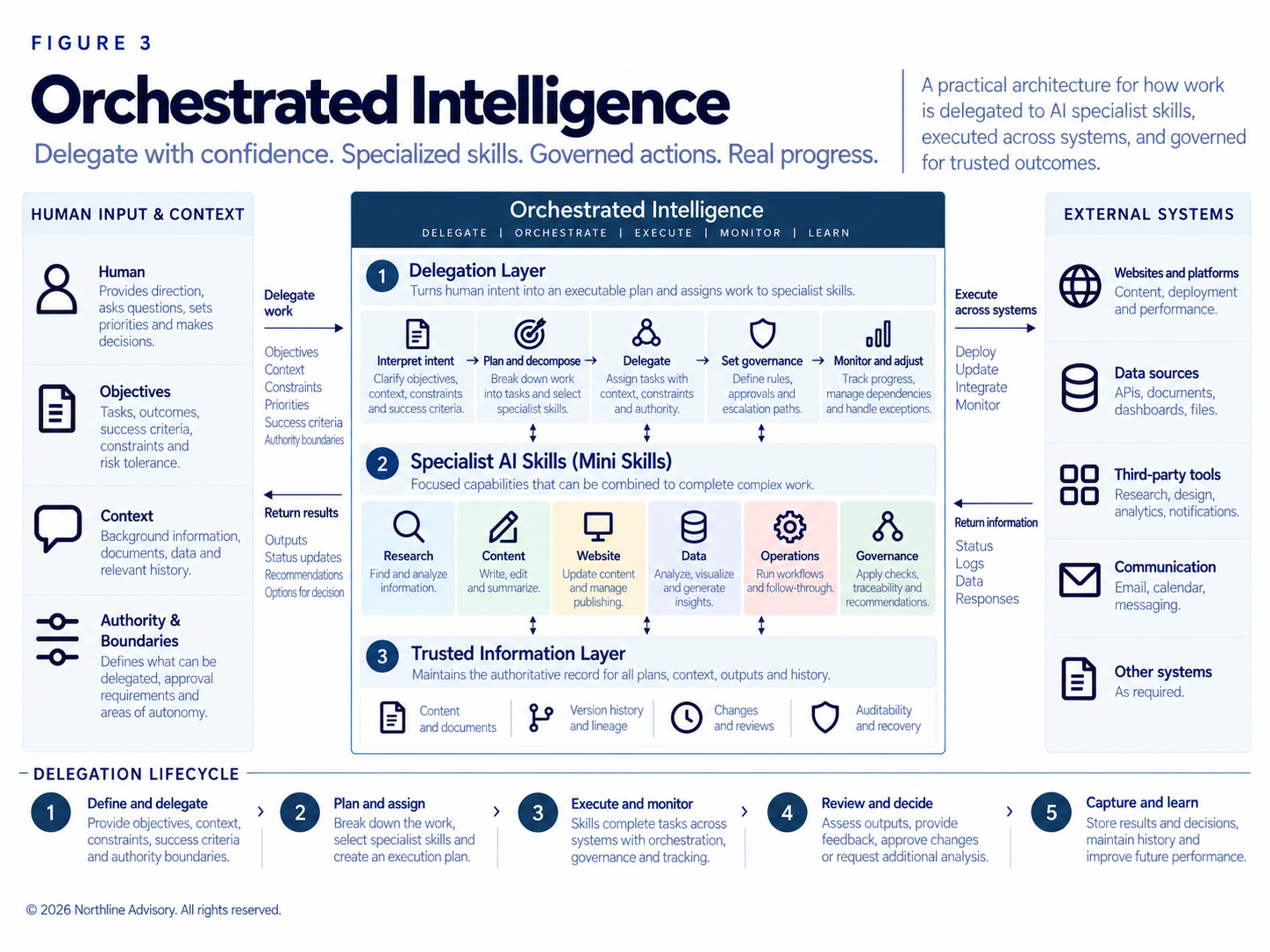
The intended model begins with a human objective rather than a sequence of individual prompts. The person establishes what needs to be accomplished, provides relevant context and defines the constraints within which the system may operate.
An orchestration capability interprets that objective, determines the work required and assigns appropriate activities to specialized AI skills.
Those skills may be responsible for research, analysis, writing, technical implementation, operations or governance. They do not all need the same tools or instructions, and their authority may differ depending on the work.
The orchestrator is responsible for coordinating their contributions, managing dependencies and identifying circumstances that require intervention.
Figure 3. Orchestrated Intelligence provides a model for coordinating specialized AI capabilities around a human-defined objective. Delegation, execution and monitoring are supported by shared information, persistent artifacts and explicit authority boundaries.
Consider the preparation of a substantive article.
The human establishes the subject, intended audience, argument and editorial requirements. A research capability identifies relevant material, while a writing capability develops the manuscript. Another capability may examine factual claims or consistency with an established writing standard. Once the manuscript is approved, a publishing capability can prepare the necessary website changes.
The individual activities are familiar. The difference is how they are coordinated.
Rather than requiring the human to move information between each step, the orchestration layer manages the sequence and the relationships between tasks. It should also recognize when the result of one activity requires another to be repeated or revised.
The human remains responsible for the direction of the work and for decisions that have not been delegated. Approving the argument of an article, for example, is different from authorizing an agent to correct a formatting problem.
Those distinctions need to be represented in the operating model rather than left to the discretion of whichever agent happens to be active.
This is an architectural direction, not a claim that connecting several AI models automatically produces dependable delegation. Coordination, authority, evidence and recovery all require explicit design and validation.
What makes delegation dependable
The most difficult part of a multi-agent system is not necessarily getting individual agents to perform useful tasks. It is ensuring that their combined work satisfies the objective and remains within the authority provided.
A research agent may complete its assignment without identifying enough evidence to support the intended conclusion. A writing agent may produce a polished manuscript that does not adequately address the original question. A publishing agent may implement the supplied content correctly even though the content has not been approved.
Each component can appear successful while the overall result remains unsatisfactory.
This is a familiar problem in organizational delivery. Completing activities does not necessarily mean that the intended outcome has been achieved.
A dependable delegation model therefore needs to evaluate the combined result, not simply collect completion messages.
The orchestrator must be able to determine whether the work satisfies the original requirements, identify material gaps and decide whether further activity is necessary. Some issues can be returned to a specialist capability for correction. Others require a decision from the human.
The system also needs reliable operational state. It must know which activities are active, what evidence supports their completion, which outputs have been accepted and where dependencies remain unresolved.
Git can preserve the history of relevant files and instructions, but it is not a substitute for this operational state. A complete architecture also needs task management, execution records, access controls, monitoring and appropriate validation mechanisms.
This separation is deliberate.
The repository maintains important artifacts and their history. The orchestration layer manages delegated activity. Evaluation mechanisms assess the results. Governance controls determine what actions are permitted and where approval is required.
Together, these components create the conditions for more dependable execution.
There is also an important feedback opportunity. When a delegated activity repeatedly fails to meet its requirements, the system can preserve the evidence, examine the cause and propose changes to the relevant instructions or workflow.
Those changes can be evaluated before becoming part of the accepted configuration.
In this way, experience can inform the improvement of the system without granting AI unrestricted authority to modify its own operating rules.
The distinction matters because improvement and control must develop together. A system that changes continuously without a dependable history or acceptance process may become more difficult to understand even as individual components appear more capable.
Delegating with confidence
The outcome I am working toward is relatively straightforward to describe, even though the engineering is more involved.
I want to be able to assign a substantial objective to a coordinated group of specialized AI agents, establish the boundaries within which they may operate and allow them to manage the work without requiring me to supervise every intermediate step.
The system should be capable of planning the activities, selecting the appropriate skills, coordinating dependencies and evaluating progress. It should recognize when information is insufficient, when an action exceeds its authority or when the combined result does not yet satisfy the objective.
When the work is returned, I need to understand what was accomplished, what changed, what evidence supports the result and which decisions remain mine.
That is what I mean by confident delegation.
It does not mean assuming that AI will always produce the correct answer or that human review becomes unnecessary. The level of oversight should reflect the consequences of the work, the reliability of the process and the authority being exercised.
For low-risk activities, the system may be able to complete substantial work independently. For consequential changes, the same architecture should support more explicit verification and approval.
The important improvement is that oversight becomes part of a managed process rather than a continuous requirement for the human to coordinate every action.
This is where the earlier discussion of Git, knowledge and history connects to the larger architectural objective.
An orchestrator needs to know which instructions govern the work. Specialist agents need access to relevant and current information. Proposed changes need to remain distinguishable from accepted ones. Earlier decisions and artifacts must be available when work is revised, interrupted or transferred.
Without those foundations, a multi-agent system can become a collection of capable assistants exchanging information without a sufficiently dependable account of what they are doing.
With them, there is an opportunity to develop a more coherent model of delegated execution.
A practical place to begin
None of this requires a casual AI user to begin building an orchestration platform.
Someone using AI to develop a business plan or write a book can benefit from creating a repository, organizing the important files and maintaining their history. The immediate advantages are practical: less confusion about versions, easier recovery of earlier work and a clearer record of how a project has developed.
As the work grows, the user can establish more consistent instructions, document important decisions and provide AI tools with access to the relevant materials.
The next step may be controlled changes, where an assistant prepares revisions that can be inspected before they replace accepted content. More sophisticated workflows can introduce evaluation, defined responsibilities and explicit approval requirements.
Only when the work justifies it does coordination across multiple specialized agents become necessary.
The progression is useful because the underlying disciplines are not wasted. Organized information, identifiable artifacts, version history and clear decision rights remain relevant as the operating model becomes more sophisticated.
There are trade-offs. Repositories require maintenance, AI tools need appropriate access, and version control is better suited to some types of files than others. Git also does not replace a knowledge-management strategy, an operational database or the controls needed for consequential automated actions.
For a small, short-lived task, introducing Git may add more overhead than value. Its benefits become clearer when work needs to persist, evolve, be reviewed or be shared across sessions and contributors.
That is the practical judgment I would encourage readers to make.
The significance of Git for AI users is not that everyone should adopt software-development practices wholesale. It is that a tool developed to manage the evolution of software can also help manage the growing body of knowledge, instructions and artifacts produced through AI-assisted work.
For some people, the benefit will be a better-organized project with a recoverable history. For others, it will become part of a more substantial foundation for coordinating specialized AI capabilities.
My interest lies increasingly in that second possibility: moving from AI as a tool I must continuously direct toward systems to which I can delegate meaningful work, while retaining the evidence, authority and control needed to trust the result.
The more capable AI becomes, the less useful it is to rely on conversational memory as the primary means of managing persistent work. Knowledge needs to remain accessible, changes need to be inspectable, and responsibility for decisions needs to be clear.
Git will not deliver confident delegation on its own. But it provides a practical starting point for building the continuity and control on which that capability depends.
And that is a good reason to understand it, even if you never write a line of code.
Steven Boyle is the founder of Northline Advisory, a technology advisory and research practice focused on technology leadership, enterprise transformation, governance, data and governed AI. His work draws on more than two decades of executive and operational experience across higher education and public-interest organizations.
Related Practitioner Insights
Practitioner Insight · Governance
Architecture Is Not Documentation. It's a Contract.
Architecture becomes valuable when it constrains implementation—preserving decisions, defining boundaries, and preventing locally correct work from violating the system as a whole.
Artifact-Oriented AI Architecture: Closing the Enterprise AI Architecture Gap
An architectural pattern for high-consequence enterprise AI systems in which probabilistic reasoning operates within deterministic governance and authority resides in governed artifacts rather than generated responses.