

Research Paper · Data & AI
Evidence Coverage and Traceability
Knowing What Supports a Conclusion
A deterministic evidence architecture for preserving and inspecting the governed relationships that actually support AI-generated conclusions.
An Applied Engineering Case
Large language models used in evidence-based decision support can generate statements that are plausible and contextually relevant but stronger than the available evidence permits. A model may correctly identify relevant circumstances while presenting their implications as demonstrated capability or established achievement. Deterministic validation can reject such claims, but rejection may interrupt a multistage workflow that has already produced valid intermediate results. Corrective regeneration introduces a further concern: changes to those results or their governing evidence may alter the conditions under which a revised output is authorized.
This note examines these problems through an operational incident in the Executive Positioning System (EPS), a governed LLM application developed by Northline Advisory. Unsupported assertions of demonstrated candidate capability were rejected by an evidence-authority validator, interrupting the workflow. A subsequent execution completed using appropriately qualified language, although differences in upstream artifacts prevented attribution of the changed outcome to model sampling alone. A bounded corrective mechanism was subsequently implemented to regenerate only the rejected Candidate Strategy while preserving specified upstream artifacts, evidence authority, schema, and instructions. Twelve required recovery tests and nineteen additional focused tests passed. An integrated regression comparison identified no additional failures. The case presents an implementation-tested approach to preserving evidentiary authority during corrective regeneration, extending established validation and recovery techniques to a specific failure of evidence-governed reasoning.
Receive the complete research note as a PDF by email.
Generative AI is increasingly used to interpret information and prepare recommendations, assessments, and documents that influence human decisions. In these applications, factual accuracy alone is not a sufficient condition for trustworthy output. A generated statement must also be supported by the evidence available to the system and expressed with an appropriate degree of certainty. A model may accurately identify an individual’s responsibilities, organizational environment, or professional experience, yet go beyond that information when describing what the individual has demonstrably accomplished.
This distinction is particularly important in evidence-based decision support. A statement that someone’s experience is relevant to a requirement differs materially from a statement that the person has proven the ability to satisfy that requirement. The first describes a relationship that may be inferred from contextual information. The second asserts an established capability and requires evidence appropriate to that claim. When a generative model fails to maintain this distinction, it can transform legitimate contextual information into an unauthorized assertion without inventing an entirely fictitious underlying fact.
Deterministic validation offers one means of controlling this problem. Rather than relying exclusively on the model to obey its instructions, an application evaluates generated statements against separately established rules and evidence requirements. Outputs that do not satisfy those conditions are rejected before becoming accepted application artifacts.
Rejection nevertheless creates an operational problem within a multistage workflow. Earlier stages may already have produced valid results, while the rejected stage remains incomplete. Repeating the entire workflow may regenerate those earlier results, potentially changing the context against which the next output is evaluated. Although a subsequent execution may succeed, its success does not necessarily establish that the original failure was corrected under the same conditions.
This problem arose during operation of Northline Advisory’s Executive Positioning System (EPS). A generated Candidate Strategy contained assertions of proven capability for which the governing candidate evidence package supplied no supporting anchors. The authority validator correctly rejected the statements, but the workflow had no local corrective mechanism and terminated before completion.
The incident motivated an architectural correction that would permit revision of the rejected output while preserving the authority under which that output had been evaluated.
This note contributes an applied account of evidentiary-authority preservation during corrective regeneration in a multistage LLM system. It examines an observed instance of unsupported capability claims, explains why correct validation rejection exposed a recovery limitation, and describes an implemented mechanism that permits bounded regeneration while protecting previously validated artifacts and governing evidence. Implementation-level verification establishes the mechanism’s behaviour under defined success and failure conditions.
The contribution is not a new general-purpose retry algorithm or authorization theory. It is an operationally motivated, implementation-tested pattern in which a rejected output may be revised without permitting the recovery operation to change the evidence and validated context governing its acceptance.
Research on governed generative systems has distinguished content generation from the authority to accept or publish it. Smith and McCarthy [1] specify a deterministic governance framework in which versioned constraints are translated into executable rules and decisions are associated with reproducible evidence records. Their work establishes an important architectural premise: probabilistic generation need not determine the governance verdict. A separate mechanism can evaluate generated content against independently established constraints.
Such validation does not, by itself, determine what an application should do after rejection. A governance mechanism may function correctly while leaving a partially completed workflow unable to advance. This becomes significant when subsequent generation depends on upstream artifacts that have already been accepted.
Automated model correction offers an established response. Pan et al. [2] survey approaches that use feedback, including feedback from external systems, to revise LLM outputs. Their analysis distinguishes correction during training, generation, and post-generation processing. Practical frameworks such as Guardrails AI [3] similarly support validation-guided corrective actions. These approaches establish that an unacceptable response can be revised without retraining the underlying model.
The unresolved concern for a particular multistage application is not simply whether another generation can be requested. It is whether the authority conditions governing the rejected output remain stable during that generation. A corrective request may reuse existing evidence, alter instructions, reconstruct intermediate context, or regenerate upstream artifacts. These operations may change the conditions under which the resulting output is evaluated.
Alpay and Alpay [4] examine a closely related integrity problem in LLM answer publication. Their work investigates exact-content binding, authorization freshness, checkpoint recovery, and recovery-induced error. It distinguishes the semantic correctness of an approval decision from the integrity of applying that approval to the appropriate content and authorization context. Their findings demonstrate that recovery can introduce additional errors and that authorization integrity cannot be inferred from the correctness of an individual approval mechanism.
This work establishes important precedent for preserving authorization context across state changes. The EPS case does not claim novelty for evidence fingerprinting, checkpoint integrity, or the general principle that previously established authorization must remain valid during recovery.
Its contribution concerns a different intervention point. Rather than the publication or restoration of an approved answer, EPS encountered a failure within an intermediate reasoning stage. The model transformed contextual candidate information into an unsupported assertion of demonstrated capability. The rejected artifact was not yet authorized, and correcting it required preserving the upstream reasoning artifacts and evidence constraints against which it would be evaluated.
The resulting engineering question is specific: how can an evidence-governed LLM workflow permit correction of an unauthorized generated claim without allowing the corrective operation to redefine the evidence, validated inputs, or acceptance rules governing that claim?
EPS is an operational decision-support application that examines executive opportunities in relation to governed candidate information. Its Foundation workflow produces three successive artifacts: Mandate, Positioning, and Candidate Strategy. Mandate interprets the organizational opportunity and its requirements. Positioning develops their strategic implications. Candidate Strategy relates the opportunity and positioning to available career context and governed candidate evidence, identifying areas of alignment, supporting proof, and evidence still required.
A central distinction in the EPS authority model is that contextual career information is not equivalent to evidence of accomplishment. Responsibilities, organizational scale, operating environments, professional history, and institutional context can establish relevance. Claims about successful execution, demonstrated effectiveness, or proven capability require governed evidence supporting those stronger assertions.
Where such evidence is unavailable, Candidate Strategy operates under a proof-required condition. It may describe contextual relationships and identify capabilities that must subsequently be demonstrated, but it must not represent those capabilities as established achievements.
EPS implements this distinction through model instructions, structured output contracts, and deterministic validation. The validator examines candidate-related assertions and rejects specified patterns of demonstrated capability when the governing evidence does not authorize them. Statements identifying outstanding proof requirements are distinguished from statements asserting that the candidate has already supplied that proof.
During a Foundation execution, the generated Candidate Strategy contained two statements that exceeded the authority of the available evidence.
The first connected a mandate’s requirement for proven ability to develop and implement integrated Data and AI operating models with the candidate’s career context. Although the context was relevant, the wording implied that the candidate had already demonstrated the required capability.
The second described the candidate as having “proven ability” to operate in environments demanding coalition-building, compliance, and formal accountability. Again, contextual experience was presented as evidence of demonstrated capability without the supporting anchors required by the governing evidence package.
The validator rejected both statements and required the assertions to be expressed as contextual alignment or outstanding proof requirements. Foundation did not complete because the workflow had no local mechanism for correcting this category of validation failure.
A subsequent execution completed successfully. Rather than asserting proven capability, its Candidate Strategy described the candidate’s environmental familiarity and executive context as relevant to the mandate’s requirements. It also identified capabilities for which supporting evidence would still be needed.
The same authority rules accepted that distinction.
| Material claim | Validator response | Workflow result |
|---|---|---|
| Career context presented as supporting proven capability without governed evidence anchors | Rejected unsupported demonstrated-capability assertions | Foundation interrupted |
| Career context presented as relevant to the mandate, with demonstrated capabilities identified as requiring further proof | Accepted contextual alignment and outstanding proof requirements | Foundation completed |
These executions preceded the corrective implementation and illustrate the evidentiary distinction enforced by the validator. They are not an experimental comparison of the original and revised recovery architectures.
The initial diagnosis attributed the different outcomes to model-output variation. Subsequent investigation confirmed that the same model identity and relevant validator implementation were used, but also established that upstream generated artifacts and execution instructions differed.
The executions were therefore not identical-input repetitions. Differences in generated wording were material to the validation outcomes, but the available evidence does not isolate stochastic generation as their sole cause.
The more consequential finding concerns the relationship between governance enforcement and workflow control. The validator correctly rejected unsupported capability claims. The operational failure arose because that rejection terminated the workflow without a local corrective pathway. Repeating Foundation could produce an acceptable result, but it also regenerated previously completed stages and introduced further variation into the context.
The engineering requirement was consequently defined more narrowly: preserve the accepted upstream artifacts and governing authority while correcting only the rejected Candidate Strategy.
In the original architecture, Candidate Strategy generation was followed by deterministic validation. A compliant output could proceed to completion, while an authority violation terminated the Foundation workflow. The validator correctly enforced the distinction between contextual relevance and demonstrated capability, but the orchestration layer treated rejection as a terminal condition.
The revised architecture retains the original validation boundary and introduces a narrowly scoped recovery pathway. When the validator identifies an eligible evidentiary violation, the application preserves the accepted upstream artifacts and governing evidence, then permits one corrective generation of Candidate Strategy. The revised output is evaluated under the same authority conditions.
The architectural change is therefore not a new validation standard. It is a controlled recovery transition that preserves the existing authorization boundary.
The implementation begins by classifying the failure. The initial Candidate Strategy undergoes schema validation, substantive-content checks, evidence-reference validation, and authority validation. A compliant response follows the ordinary acceptance pathway. Only a specifically classified authority-validation failure permits corrective regeneration. Schema violations, invalid evidence references, missing authority context, configuration failures, and unexpected exceptions do not authorize this recovery operation.
When an eligible failure occurs, EPS retains the rejected output and constructs a corrective request containing the original instructions, authority package, and validator findings. The model is directed to revise the unsupported assertion without introducing additional evidence or changing governing constraints.
Preservation is enforced through fingerprints of defined upstream artifacts and control inputs: Mandate, Positioning, the evidence-authority strategy, provider contract, response schema, and governing instructions. The recovery mechanism checks these protected values for the required invariance. Changes to them invalidate the corrective operation rather than being silently incorporated into a new authorization context.
This boundary is significant because the model is permitted to modify the rejected Candidate Strategy, not the information or rules that establish what the strategy may legitimately assert.
The regenerated response is subjected to the same validation pathway as the original. Unknown evidence identifiers are rejected against the governing package, response structures must conform to the established schema, and required strategy sections must contain substantive content. A corrected output cannot satisfy the recovery mechanism merely by adding unsupported evidence references, changing its schema, or removing the content required by the strategy contract.
The corrective pathway allows one additional generation. This limit is maintained across applicable resumed execution so that interruption or restart cannot create an unrestricted sequence of attempts. Both generation attempts and their dispositions are retained in the execution audit. If the revised Candidate Strategy remains noncompliant, the workflow terminates without another corrective generation.
The architectural distinction is shown in Figure 1.
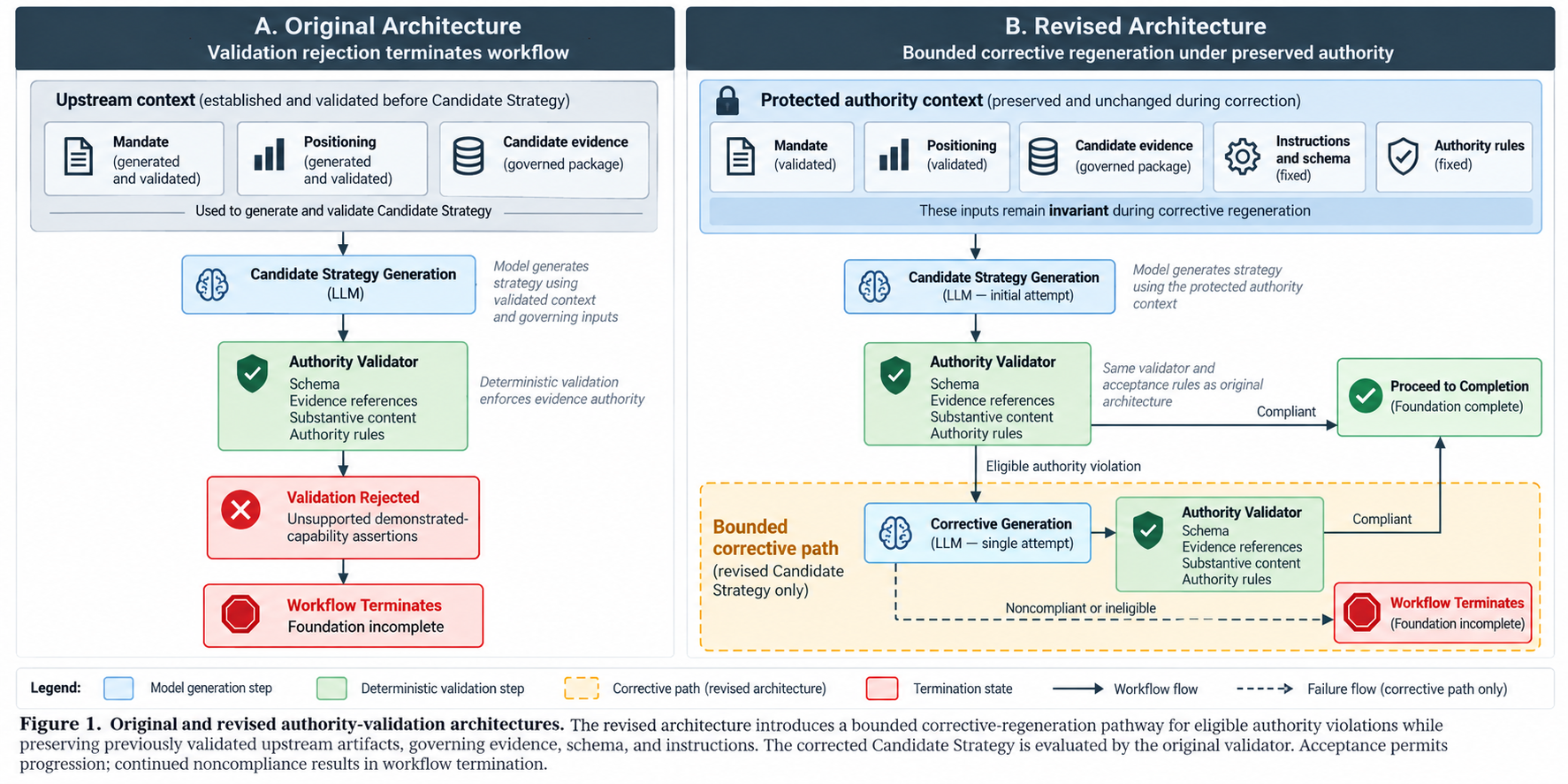
The implementation does not establish that every environmental change can be detected or that corrected outputs are semantically identical to their predecessors. Its enforceable property is narrower: the specified protected authority context must remain unchanged during the eligible corrective operation, and acceptance continues to depend on the original validation rules.
The correction was evaluated through deterministic tests exercising Candidate Strategy orchestration and the existing validation pathways with controlled model responses. This method permitted successful and unsuccessful correction conditions to be reproduced without requiring the model provider to generate a particular violation spontaneously.
The required tests examined normal acceptance without correction, rejection of unsupported capability assertions, acceptance of a compliant response following one eligible corrective generation, and termination when the revised response remained noncompliant. Additional conditions included preservation of accepted upstream artifacts, rejection of unauthorized evidence references, detection of changes to protected authority inputs, schema and substantive-content enforcement, and exhaustion of the permitted generation attempts across resumed execution.
All twelve required recovery tests passed, together with nineteen additional focused lifecycle and context tests. The audit mechanism retained the attempt sequence, validator findings, corrective actions, and final dispositions.
Integration was assessed against an existing 250-test regression suite. The preserved baseline and corrected implementation produced identical outcomes: 244 passing tests, two failures, and four errors. The non-passing cases existed before the correction, and no additional failures were observed in the integrated comparison.
These results support two distinct findings.
First, the defined corrective pathway behaved as specified under controlled test conditions, including acceptance after a compliant correction and fail-closed termination for noncompliant or ineligible conditions.
Second, the implemented checks preserved the specified authority and execution-state constraints during those tests. A repaired Candidate Strategy was evaluated through the original validation process rather than a separate acceptance mechanism.
The broader regression comparison indicates that no additional failures were observed in the reported suite. Because the suite retained existing non-passing cases, the comparison does not establish complete regression certification of the application.
The results also do not measure the proportion of naturally occurring provider-generated authority violations that the correction would resolve. The preserved verification evidence does not include a provider-backed execution of the corrected recovery path. The tests establish conformance with defined recovery requirements, not a population-level estimate of operational effectiveness.
This distinction matters because a correctly governed recovery operation need not always produce an acceptable response. Refusing an unauthorized revision and terminating with an accurate failure disposition is itself a required outcome.
The EPS incident illustrates a form of evidentiary overreach in generative decision support. The rejected statements were not unrelated to the candidate’s professional context. Their failure arose because the generated interpretation claimed more than that context established.
A system may possess reliable information about an individual’s responsibilities, organizational environment, and experience without possessing evidence that particular results were achieved. Contextual relevance can support an assessment of potential alignment, but it does not automatically establish demonstrated effectiveness.
The original EPS validator enforced this distinction. It prevented unsupported capability assertions from becoming accepted strategy artifacts, but the resulting interruption exposed a separate deficiency in the workflow’s ability to recover.
One possible response would have been to strengthen the generation prompt. More explicit instructions could reduce unsupported assertions and might improve first-pass acceptance. However, stronger instructions would not independently establish that generated claims satisfied the evidence-authority contract. Nor would they resolve the consequences of a rejection after earlier stages had already completed.
Another response would have been ordinary validation-guided re-asking. This is established practice and may be sufficient where the authorized context is supplied unchanged to each generation. The EPS problem arose because its Candidate Strategy depended on upstream generated artifacts and governed evidence whose status needed to remain stable during correction.
The additional architectural requirement was therefore not simply another model call. It was enforceable preservation of the authority context while that call occurred.
The correction addresses this requirement by separating the mutable rejected output from the protected inputs and rules governing its acceptance. The model may revise Candidate Strategy, but the recovery operation must retain the specified upstream artifacts, evidence authority, and validation conditions. A change to protected context prevents the operation from proceeding under the assumption that the original authorization conditions still apply.
This design connects deterministic governance with feedback-guided correction while preserving their distinct responsibilities. Governance establishes which claims may be accepted. Corrective generation supplies a revised candidate response following rejection. The recovery mechanism controls which changes are permissible between those operations.
The contribution is therefore more specific than combining validators with retries. It demonstrates how the relationship between authorization and correction can be enforced in a multistage application where upstream generated artifacts form part of the downstream authority context.
The approach complements existing work on authorization integrity. Alpay and Alpay [4] examine semantic approval, content-bound publication, evidence freshness, and recovery-induced errors. EPS addresses a different point in the application lifecycle: an unaccepted intermediate reasoning artifact whose correction must not alter the upstream evidence and validated reasoning context. Both settings illustrate why recovery should be treated as an integrity-sensitive operation, but their immediate objects of protection differ.
The EPS implementation supports an applied architectural conclusion rather than a universal correctness guarantee. The validator identifies specified patterns of unsupported capability assertion; other forms of semantic overstatement may remain undetected. The substantive-content checks also do not establish semantic equivalence between the rejected and revised strategies. Two compliant Candidate Strategies may emphasize different aspects of a mandate while remaining within the same evidentiary boundaries.
These limitations separate preservation of authority from the broader question of recommendation quality. Keeping governing evidence and validation rules fixed does not guarantee that a corrected recommendation is optimal, complete, or preferred by a human reviewer. It establishes a controlled boundary within which those further judgments may be made.
The engineering pattern may apply to other multistage LLM systems in which accepted intermediate artifacts, evidence packages, or policy constraints determine the admissibility of downstream claims. Its practical relevance depends on the ability to identify protected state, classify recoverable failures, and enforce an unchanged acceptance process.
The present case demonstrates one implementation of those requirements. Further evaluation would be needed to establish recovery effectiveness across other applications, validators, and model-provider conditions.
The EPS case demonstrates how a generative model can transform legitimate contextual information into an assertion of demonstrated capability that the available evidence does not authorize. Deterministic validation correctly rejected those claims, but the resulting interruption exposed the need for a recovery mechanism that preserved the conditions under which the claims had been evaluated.
Northline implemented a bounded corrective-regeneration pathway that protects specified upstream artifacts, evidence authority, and governing constraints while permitting one revision of the rejected Candidate Strategy. The repaired output remains subject to the original validation rules. Controlled tests verified the intended enforcement conditions, recovery limits, failure dispositions, and state-preservation requirements.
The contribution is an operationally motivated and implementation-tested architecture for preserving evidentiary authority during corrective regeneration. It demonstrates how an evidence-governed LLM workflow can permit revision of an unauthorized generated claim without permitting the corrective operation to redefine the evidence and validated context governing its acceptance.
This note reports an operational incident, an implemented corrective mechanism, and source-controlled engineering verification in EPS. The incident and diagnosis are supported by preserved execution records and application evidence. The corrected mechanism was assessed through deterministic recovery tests, additional lifecycle tests, and comparison with an existing regression baseline.
The evidence supports the specified authority-preservation and fail-closed behaviours under controlled test conditions. It does not establish universal detection of evidentiary overreach, semantic equivalence of regenerated outputs, or recovery effectiveness across repeated live provider executions. The broader regression comparison retained pre-existing non-passing cases. Detailed implementation records and test results are maintained in Northline’s supporting engineering evidence package; the underlying application and candidate records are not presented here as a publicly reproducible dataset.
Generative AI tools assisted the investigation of the software failure, development and testing of the corrective implementation, technical documentation, literature organization, and manuscript drafting. Operational observations originated from EPS execution records, and reported verification results were produced by executed engineering tests. AI-assisted interpretations and manuscript text were assessed against the available evidence. Responsibility for research conclusions and publication approval remains with the author.
Series: Northline Research — Applied Engineering Notes. Status: Approved manuscript v1.4. Research Area: Governed AI Systems, Evidentiary Authority, Runtime Assurance. Author: Steven J. Boyle, Northline Advisory. © 2026 Northline Advisory. All rights reserved.
Receive a link to the complete research note by email.
Steven Boyle is the founder of Northline Advisory, a technology advisory and research practice focused on technology leadership, enterprise transformation, governance, data and governed AI. His work draws on more than two decades of executive and operational experience across higher education and public-interest organizations.
Knowing What Supports a Conclusion
A deterministic evidence architecture for preserving and inspecting the governed relationships that actually support AI-generated conclusions.
Engineering Reliable Software When the Implementer Is Probabilistic
An implementation-grounded model for constraining probabilistic software development through deterministic architecture, certification and baseline controls.
How AI Systems Can Learn Without Turning Experience Into Truth
An evidence-grounded architecture for using decision history as an advisory signal without allowing experience or frequency to become factual authority.